
What sits underneath the payment button
Mollie’s Pay by Bank announcement made me revisit the routes beneath online checkout, and the commercial choices shaping Europe’s bank-based payments.


A few weeks ago, I wrote about helping my mother-in-law buy a flight ticket in Switzerland. Her Visa payment failed, while a payment with TWINT took only a few moments. In that piece, I was interested in what the experience felt like: the complexity was still there, but my mother-in-law did not have to deal with it.
Mollie’s announcement of a renewed Pay by Bank offering brought me back to payments from another direction. I have not used the new flow at checkout. Reading about it made me reconsider the diagram I had been drawing of how online payments work. A checkout can make different methods look much the same, even when the money takes a different route.
Two routes beneath the buttons
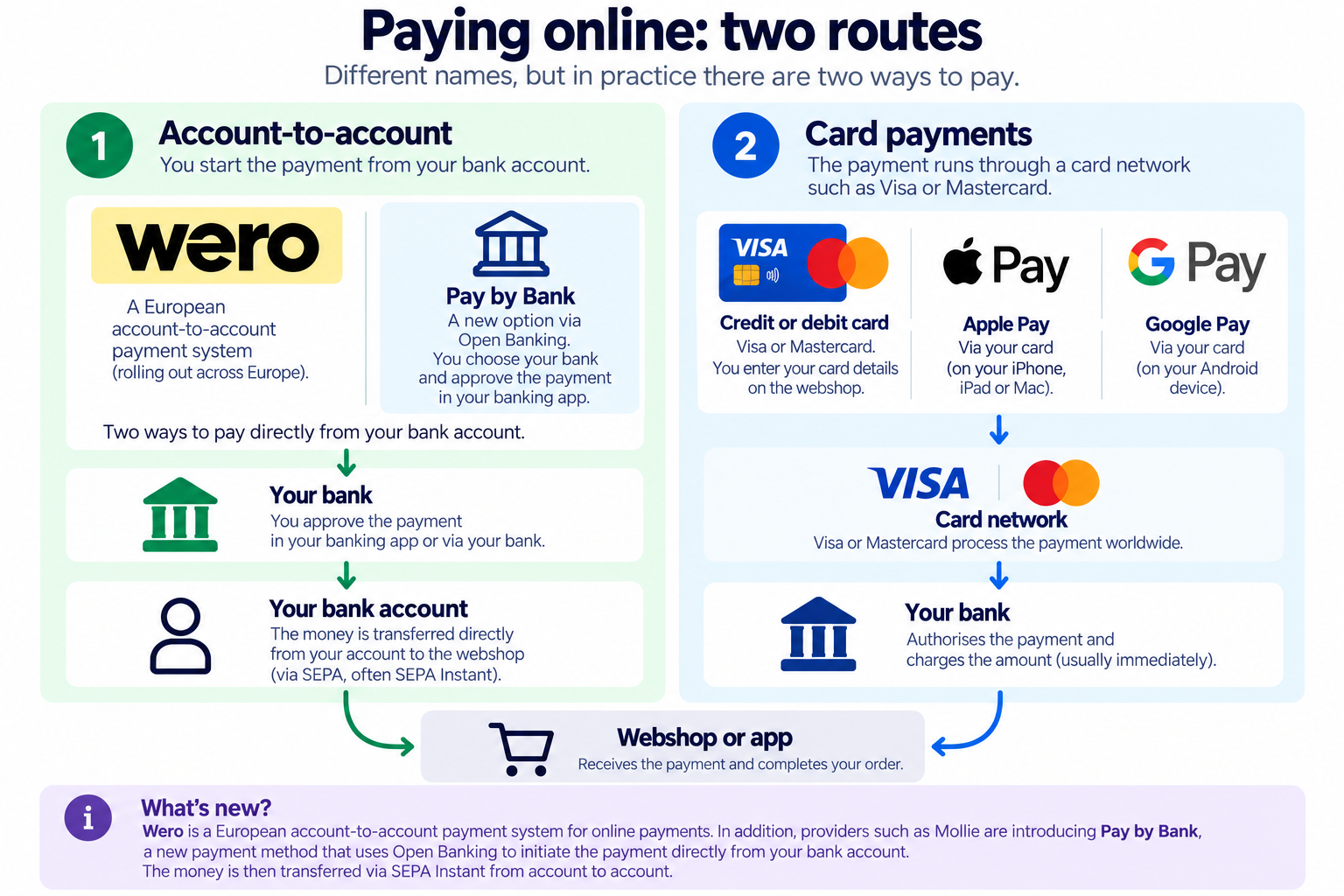
For the methods I was trying to compare, my diagram separates two broad routes. A card payment travels through a card network such as Visa or Mastercard. Apple Pay or Google Pay may change how I present the card and approve the payment, while the card network remains underneath.
The other route starts with a bank account. In the Netherlands, iDEAL has long made bank-based online payment familiar. Wero is gradually taking its place as part of a wider European rollout. Mollie’s Pay by Bank also lets a customer choose a bank and approve a payment through that bank, using Open Banking access to initiate a transfer.
These are broad routes, not a complete account of everything offered at checkout. The diagram helped me notice something it did not initially explain: Wero and Pay by Bank can appear similar to a customer, although they come from different parts of the payment system.
Where I had placed the PSP
I had thought of a payment service provider such as Mollie mainly as the party that helps a merchant accept methods built elsewhere. Mollie brings cards, iDEAL and other options into one checkout. In my mental picture, the PSP sat between the merchant and those established systems.
Pay by Bank makes that picture less tidy. With the customer’s permission, a provider can use Open Banking access to initiate a payment from the customer’s bank account and shape the experience around it. In Mollie’s described flow, the money moves from the customer’s account to Mollie, then appears in the merchant’s balance. The transfer can be instant, although Mollie says a standard transfer may sometimes be used.
This is more than adding another logo to a merchant’s list of payment methods. The PSP can assemble a bank-based checkout experience from access to banks, transfer infrastructure and its existing relationship with the merchant.
Similar at checkout, different underneath
Wero is a European payment scheme with its own rules and product. Pay by Bank is Mollie’s offering built around bank access and transfers. Both can offer an account-based route that does not require a Visa or Mastercard card transaction, but they should not be treated as interchangeable. Reach, payment timing and the arrangements for merchants and customers may differ.
The pricing makes that distinction less abstract. As I write this, Mollie’s Dutch price list puts a domestic Wero payment at €0.32 and Pay by Bank at 0.45% plus €0.25. On a €50 purchase, that is €0.32 versus about €0.48.
But there is an interesting wrinkle. After I shared my comparison, Mollie founder Adriaan Mol replied that Pay by Bank will become cheaper than Wero. He did not say whether that refers to the standard tariff, volume pricing or a pricing change still to come, so I would not read more into it yet.
The European question
Europe’s dependence on international card schemes is real. The European Central Bank has documented how heavily card payments in many European countries rely on them. Wero is an attempt to build a European payment scheme at scale. Pay by Bank shows how a PSP can use banking infrastructure to offer another account-based experience at checkout.
The Swiss experience made me think about how little of a payment’s complexity the customer needs to see. Mollie’s announcement has me looking at a different side of the same question. Europe can make more than one bank-based route available. Whether those routes become useful choices will depend on how they are packaged, priced and accepted by merchants, as well as on what happens when a payment or a purchase goes wrong.