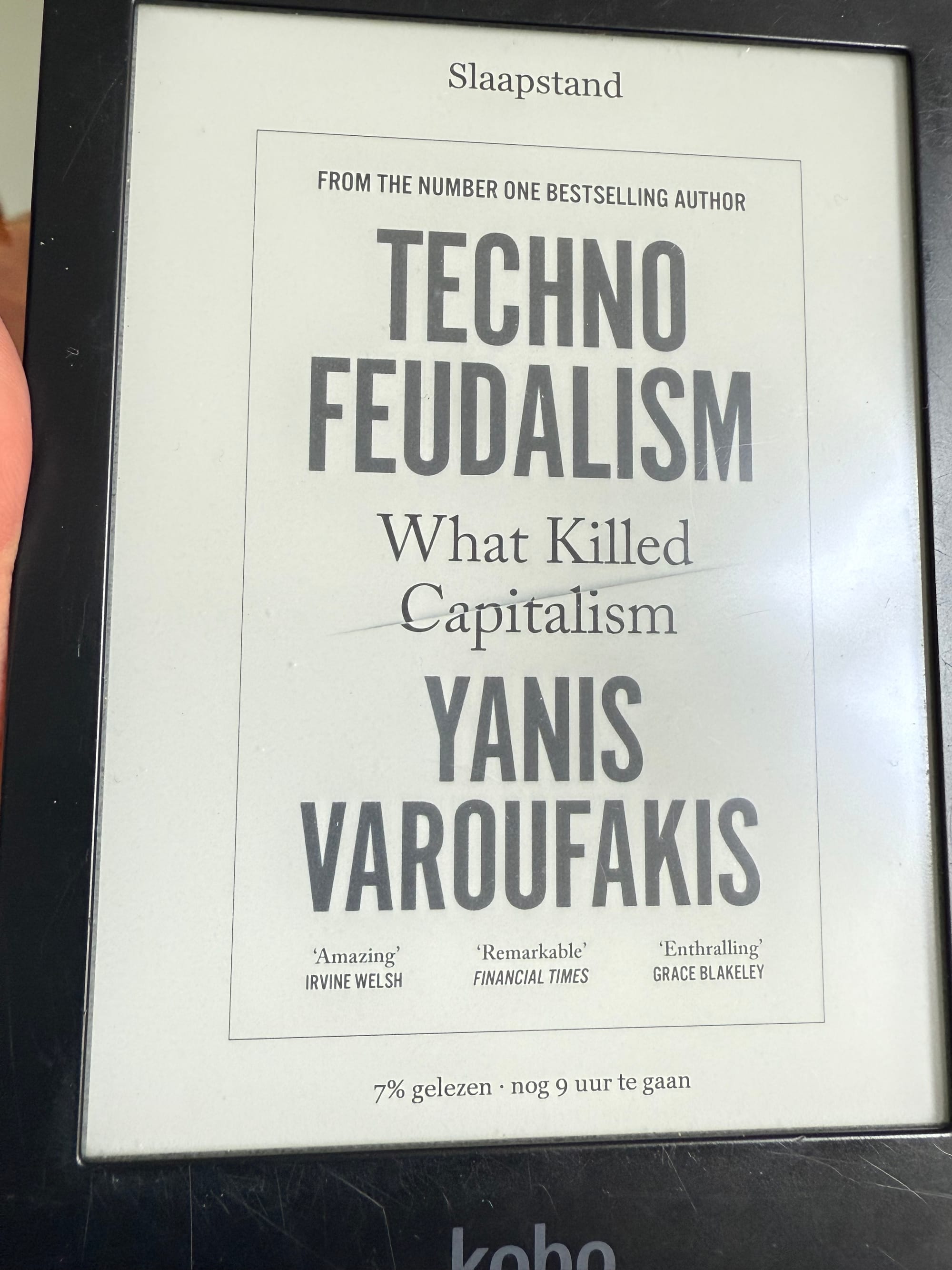
Review: Technofeudalism by Yanis Varoufakis
Reading Varoufakis, I realised it’s not capitalism’s future I’ve been sensing shift but its absence. Something else has quietly taken its place.


I’ve always found Yanis Varoufakis a fascinating figure. During the Eurozone crisis, he stood out, not just for his opposition to Jeroen Dijsselbloem and the Eurogroup’s austerity line, but for the way he carried himself: energetic, theatrical, unafraid of being dismissed. At the time, I didn’t always agree with him. Still, he stuck with me.
So when I picked up Technofeudalism, I wasn’t entirely sure what to expect. I knew Varoufakis had a tendency toward provocation, but I didn’t realise how well this particular provocation would line up with the questions I’ve been asking myself lately. About digital identity, the role of Big Tech, the power of platforms, and the strange inertia of the European project.
In a way, the book landed in my intellectual life at just the right moment.
 Yanis Varoufakis
Capitalism is dead. Long live technofeudalism.
The central claim of Technofeudalism is simple, and deliberately unsettling: capitalism is over. What replaced it isn’t socialism or collapse, but something worse, more subtle, more opaque. Varoufakis calls it technofeudalism, and he means it quite literally.
The book argues that we no longer live in a system where markets and profits sit at the heart of economic life. Instead, we live under the rule of cloud capital: the platforms, infrastructures, and interfaces owned by Big Tech firms that now mediate not just consumption, but production, communication, mobility, even governance.
Where capitalism thrived on competition and risk, technofeudalism thrives on rent. Not profit through innovation, but access fees to digital fiefdoms. We don’t buy products from a market; we are granted the right to use services, under opaque terms, inside walled gardens.
These platforms are not markets. They are private territories, ruled by algorithms and enforced through code.
The logic of rent and the disappearance of profit
This was one of the book’s most clarifying insights for me: the idea that the dominant logic of today’s economy is no longer entrepreneurial, but feudal. Take Google, Amazon, Facebook, Apple. Their primary asset isn’t capital in the industrial sense, machines, tools, labour, but the ability to enclose and monetise digital space. They extract value not through competition, but by controlling access and owning the context.
“Where power once derived from owning machines and land, it now flows from owning the cloud and the algorithm.”
Varoufakis calls the income they extract cloud rent. And once you see it that way, many of today’s puzzles begin to make sense. Why do these companies become more powerful the more data we give them? Why does their dominance feel so hard to challenge, even when they appear to be free services? Why do they increasingly behave like nation-states?
It’s not just Big Tech that changed. The book argues that the 2008 financial crisis, and the central bank interventions that followed, helped accelerate the shift.
Instead of restructuring debt or reforming finance, central banks injected trillions of dollars and euros into the system. The result wasn’t renewed capitalist productivity, but a surge in asset prices: real estate, stocks, platform valuations.
In effect, capital mutated. Not into something more productive, but into something more parasitic. Platforms didn’t just benefit from these interventions, they became the main architecture through which post-2008 value was stored, multiplied, and extracted.
Digital accounts as passports
For me, the most powerful metaphor is one Varoufakis doesn’t quite spell out but the book makes impossible to ignore: the digital account as a kind of passport.
When you create a Google account, an Apple ID, a Facebook login, you’re not just joining a service. You’re entering a jurisdiction. Your account becomes your access point, your identity card, your means of mobility, your ability to work, communicate, transact.
Lose it, and you’re not just logged out—you’re locked out of a part of your digital life.
“Logged into our accounts, we enter a domain where our identity is both constructed and contained—useful, but no longer our own.”
This idea dovetails with some of the writing I’ve been doing on digital identity. We used to think of identity in legal or social terms, who you are in the eyes of the state or your community.
Increasingly, though, identity is platform-native. And it’s not owned by you. It’s issued, managed, revoked or monetised by companies who operate above the level of democratic scrutiny.
The account is the passport. The platform is the territory. We are not users, we are serfs.
 Rob Hoeijmakers
Where Europe fits in
The book doesn’t dwell on the European Union, but its implications are everywhere. Europe, as Varoufakis knows well, lacks both a common economic engine and a coherent digital strategy.
It depends on American platforms, borrows regulatory legitimacy from national governments, and struggles to articulate a vision for digital sovereignty that isn’t just defensive.
In this sense, Technofeudalism is also a book about European weakness. Not just economically, but institutionally. The tools we once used to discipline capital, public services, industrial policy, democratic institutions, have little traction in a world where economic power lives in server farms and UX design.
“Europe’s failure to democratise its economic governance mechanisms handed immense power to unelected technocrats and paved the way for platform dominance without resistance.”
And while the EU dreams of being a regulatory superpower, it’s doing so inside someone else’s infrastructure. That should give us pause.
 Rob Hoeijmakers
A personal reading
What I appreciated most about the book wasn’t its argument as such, I don’t think Varoufakis is trying to predict the future, but its reframing of the present. He’s giving language to something many of us have been feeling for a while: that we’re in something new, but we don’t know what to call it. And because we don’t have a name for it, we struggle to confront it.
What stays with me is not whether I agree with his overall argument, but how clearly he shows the structures beneath the surface.
This isn’t a book that offers a programme, nor does it follow any single ideological line to its end. It’s more interested in naming what has changed, in connecting technology, money, labour, and identity into one readable arc.
Varoufakis moves between economic history, personal memory, and systemic critique with unusual fluency. That ability to trace large-scale shifts without collapsing into fatalism or dogma is, to me, what makes the book valuable.
As Fredric Jameson put it, “naming is not a luxury, it is a necessity.” And Varoufakis takes that seriously. He dares to name the system we’re already living in.
In that sense, Technofeudalism is a book not about the end of capitalism, but about the importance of naming what comes after. And about asking what kind of subjects, what kind of identities, we want to become in the process.
Do I recommend reading the book?
I definitely recommend reading this book.
Varoufakis is not only a sharp economic thinker, he’s also a compelling writer. What surprised me most is the tone: personal, steady, often warm. Much of the book is framed as a conversation with his recently deceased father, with whom he shared both political ideals and a fascination with iron and technology.
That conversation, between citizen and theorist, between father and son, gives the book a kind of moral clarity that’s rare in economic writing.
It’s a book that invites you to think about power, not just as a structure, but as something we’re all entangled in. And to sharpen your mind and ideas, you don't have to agree.
 Carole Cadwalladr
 Rob Hoeijmakers
 Rob Hoeijmakers