
W Social: Isn’t This Just Bluesky?
I joined W Social expecting a new European alternative to X, only to discover I was effectively back on Bluesky. So what actually makes W different?


A couple of years ago, I wrote about finding my way across social media platforms. Two years later, the collection has only grown. X, LinkedIn, Threads and Bluesky, each with its own audience and peculiarities. I mainly use them to share my writing, discover interesting people and occasionally join a conversation.
So naturally, I signed up for another one.
W Social is a new European alternative to X. I'd read about it earlier this year and somehow got the impression that it was an EU initiative. It isn't. W is a private Swedish company. Still, European infrastructure and a focus on verified users sounded interesting, so I went through the identity check and created an account.
Only to discover that I'd essentially joined Bluesky. Again.
Wait, isn't this Bluesky?
Well, not exactly. W and Bluesky use the same underlying open network, built on the AT Protocol. That means people on the two services can follow each other, see posts and join the same conversations. They are different services, but they aren't separate social worlds.
The embarrassing part is that I explained the AT Protocol on this very blog back in 2023. Apparently, I should read my own articles more often.
I even considered moving my existing Bluesky account, with its 500 or so followers, to W. W supports that kind of account migration. But having signed up already, I decided to start fresh.
Collecting social media accounts is becoming a hobby.
So what's different?
Most obviously, identity verification. Before I could post, I had to verify myself through a separate app. W wants to know that accounts belong to real people, while allowing users to remain pseudonymous in public. The social platform itself doesn't receive your passport or full verified identity as part of the normal process.
The idea is to make impersonation, fake accounts and automated manipulation harder. Whether that leads to better conversations is an open question. LinkedIn suggests that knowing who's talking doesn't automatically make the conversation more interesting.
There's also the European aspect. W is Swedish and hosts account data in Europe. But parts of its service still rely on shared AT Protocol infrastructure, including systems developed by the American company behind Bluesky. A completely independent European network it is not, at least not yet.
Perhaps that isn't the right test anyway. Rather than build another closed platform and ask everyone to move, W can join an existing network while making different choices about identity, governance and hosting.
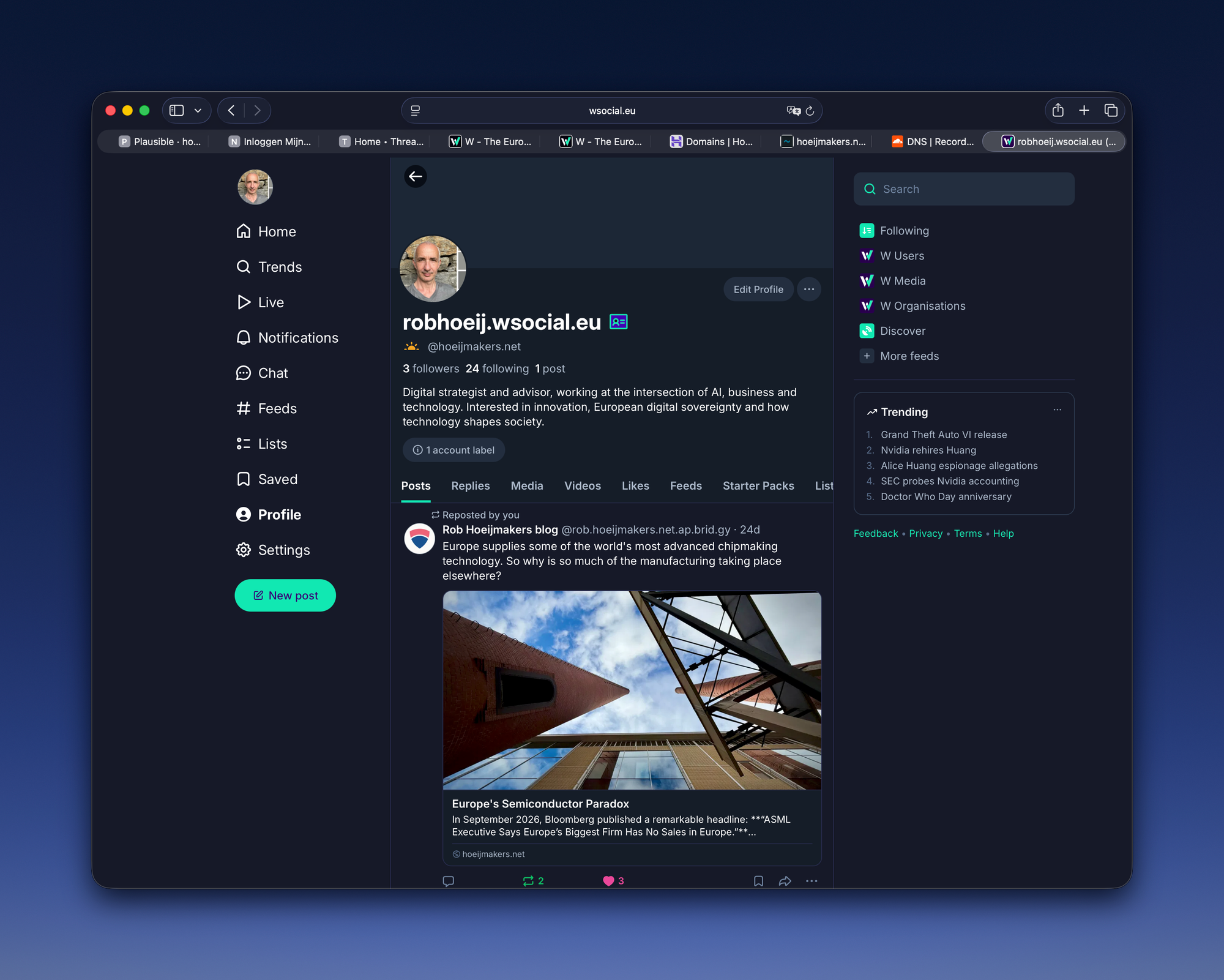
Another account. Another experiment.
I've been curious about this kind of openness for a while. Last year, I even connected my blog to the Fediverse, which uses a different protocol but shares some of the same ambitions.
I probably wouldn't have created a separate W account if I'd understood its relationship with Bluesky beforehand. But I like the idea of different services sharing a network rather than competing to own every conversation.
Will W's identity rules make any difference? I don't know. That's something worth finding out by actually using it.
For now, I'll give it a try. Although at some point I really should stop collecting social media accounts.
My account on W Social is @hoeijmakers.net.