
Between Idealism and Reach: Trying Out the Fediverse
Trying the Fediverse through Ghost: not a viral channel, but a quiet protocol that reimagines publishing as conversation instead of distribution.


I recently enabled ActivityPub on my Ghost site. In theory, this turns my blog into a social account that can be followed from Mastodon, and through a bridge, even from Bluesky.
It’s part of what’s called the Fediverse: a growing web of platforms that exchange posts and reactions without belonging to a single company.
It sounded like a quiet revolution: the open web becoming social again.
What it is
ActivityPub is a protocol, not a platform. It describes how websites can publish and subscribe to each other’s posts, much like email or RSS once did.
The collection of services using it, Mastodon, Pixelfed, PeerTube, WriteFreely, and now Ghost, form the Fediverse. Each server is independent, yet connected through shared standards.
The idea carries a certain idealism: ownership, decentralisation, resilience. A social web that doesn’t depend on a handful of companies.
What it looks like in Ghost
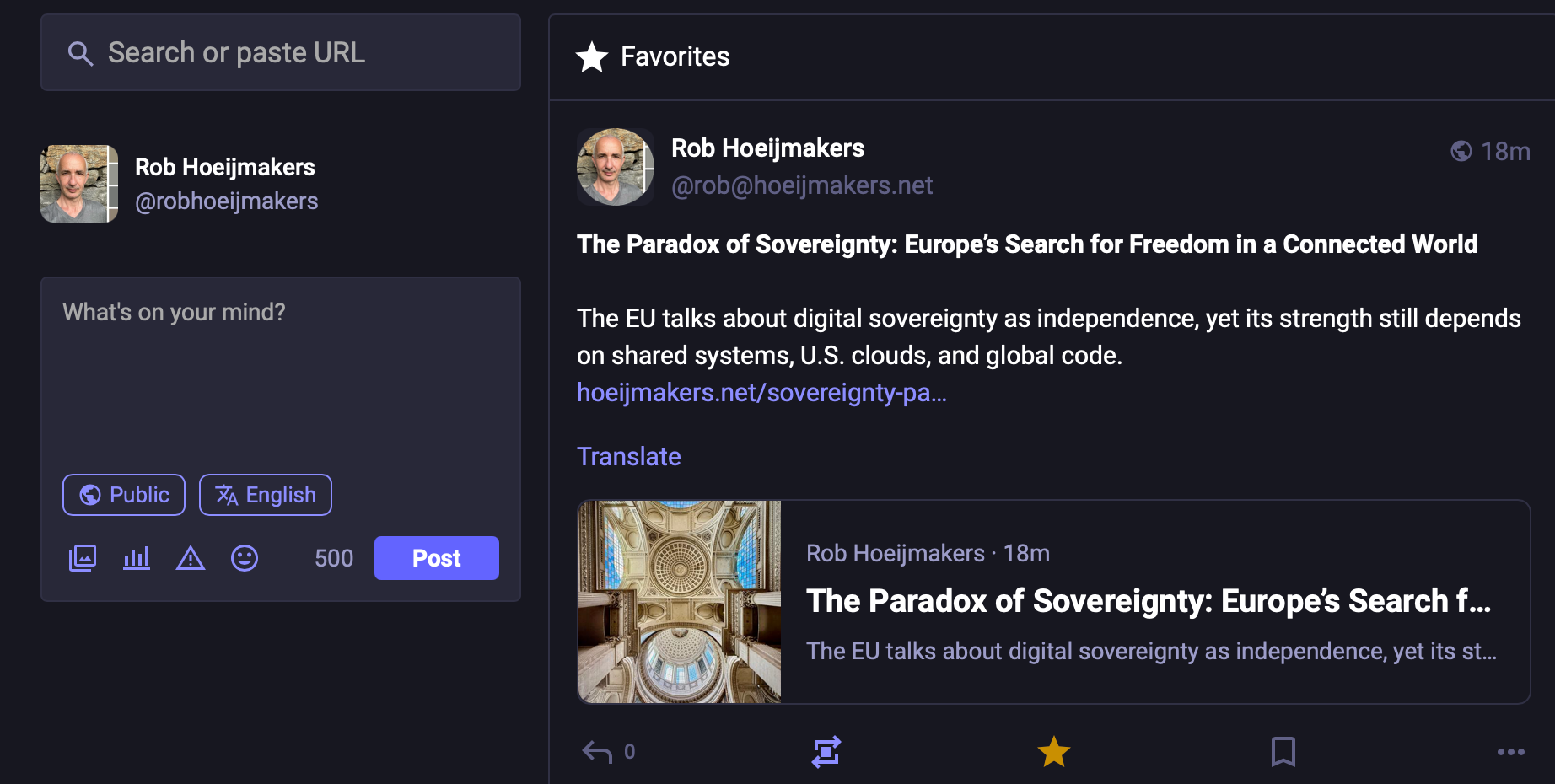
In practical terms, my site now has a handle: @rob@hoeijmakers.net. People on Mastodon can follow it. When I post, it appears in their feed; replies return to a small inbox in Ghost. A bridge forwards the same posts to Bluesky.
From the outside, it feels like a modest reappearance of something older: RSS, but social.
What it feels like
After a few days of use, it works, but quietly. Posts appear; there’s little sense of reach or movement. Threads doesn’t support it yet, and mainstream networks like X or LinkedIn live on other protocols entirely.
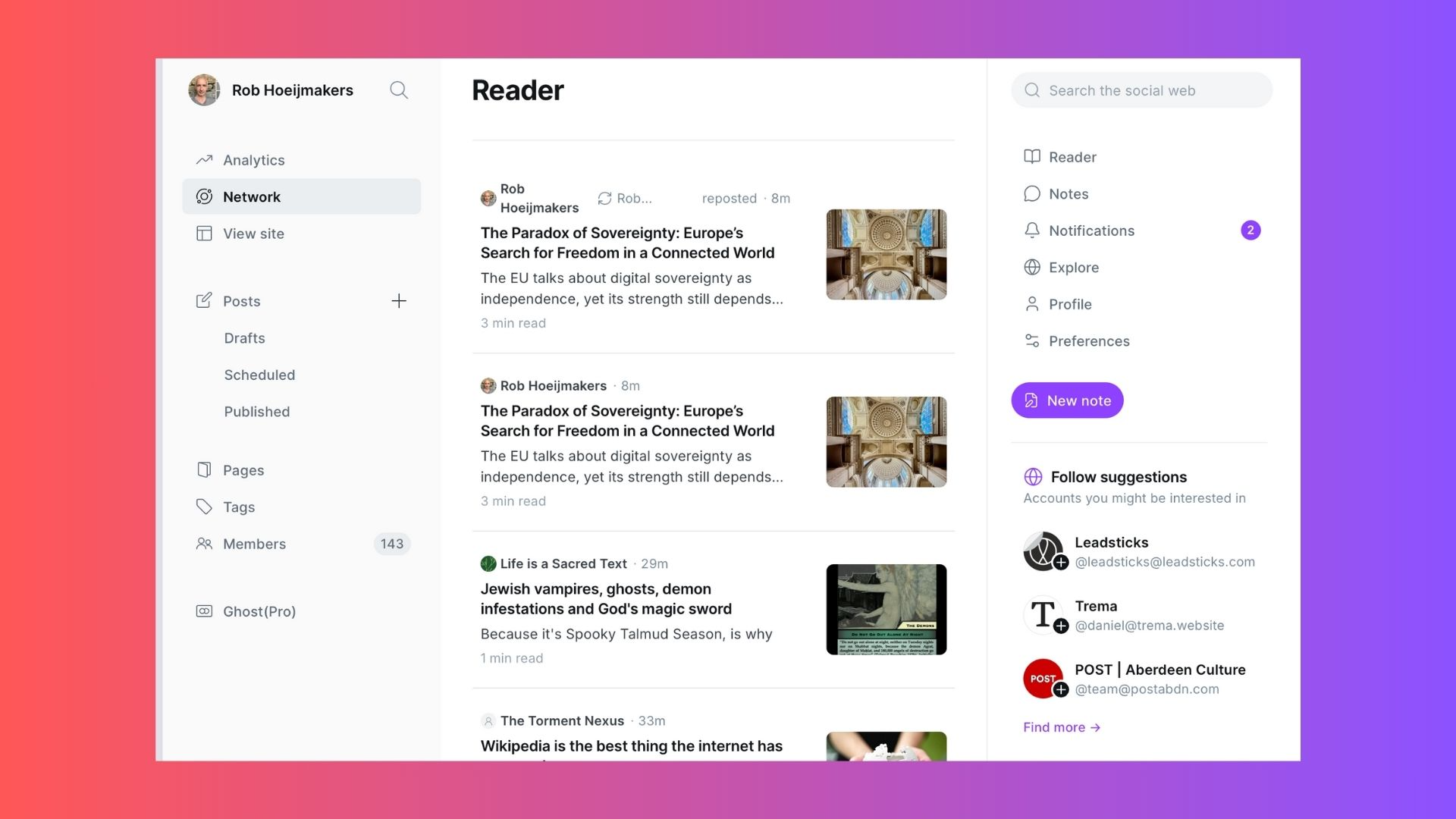
The more interesting part is the reading side: Ghost’s new social reader lets me follow others, which feels a bit like Substack’s built-in community — not big, but intentional.
Between idealism and pragmatism
It depends what you hope for.
If your goal is to build a resilient, independent network in a time of growing platform control, ActivityPub is a principled step.
If your goal is to reach readers at scale, it’s not there yet; automation, analytics and network effects still belong to the centralised world.
I approached it as a publisher, curious about distribution. But what I found instead was a small reminder of the web’s original ethos: publishing as a shared act, not a transaction.
 Ben Werdmuller
My personal take
So I keep it on. It costs little, and perhaps that quiet idealism is part of its charm. The Fediverse may never rival the scale of today’s platforms, but it keeps alive the idea that the web itself can be social without permission.
I would be really happy to see my articles go to Threads as well, but it is not clear to me how and when that will work.
Last March, we made sharing to the fediverse possible for people 18+ with public Threads profiles in the US, Japan and Canada. Then in June, we expanded globally, excluding the European Region.
Since then, we’ve made it possible for you to see the people from other fediverse servers who like your posts and follow you and enabled you to follow people from other fediverse servers.