
The limits of “unlimited” mobile data
Unlimited data rarely means the same thing twice. At home, abroad, or on eSIMs, the limits shift. This piece maps where they actually are.


A European perspective, based on lived experience
“Unlimited data” sounds simple. It suggests freedom, predictability, and one less thing to worry about. Yet if you have travelled within Europe, compared mobile plans, or suddenly hit a slowdown abroad, you will probably have felt that something about “unlimited” does not quite add up.
This piece is not a technical deep dive, nor an exposé. It is an attempt to digest my own experiences with mobile data plans in a European context and to make the underlying patterns a bit more legible. The hope is that this helps others when they run into the same quiet confusion and have to make a choice themselves.
The key idea is simple: unlimited is not one thing.
Unlimited depends on context
Within Europe, the word unlimited is used across very different situations. The confusion starts when we assume it always means the same thing.
In practice, I keep running into three distinct models.
1. Unlimited at home
Within your home country, an unlimited mobile plan usually means:
- No predefined monthly data cap
- Normal 4G or 5G speeds
- A fair use policy that exists, but is rarely felt in everyday use
There is no daily allowance, no visible counter, and no routine throttling. Heavy use is acceptable as long as it looks like normal personal behaviour.
This model works because domestic networks are predictable. Operators control the infrastructure end to end and rely on statistical averaging. Some people use a lot, most people do not, and it balances out.
For many users, this is what “unlimited” intuitively feels like.
2. Unlimited, but roaming within Europe
The moment you cross a border, even within the EU, the meaning shifts.
On an unlimited domestic plan, roaming typically comes with:
- A clearly defined monthly roaming allowance
- A hard ceiling, not a soft suggestion
- A stop, surcharge, or required add-on once the allowance is used
This is where many people first notice the limits of unlimited.
It is not a trick or an exception. Roaming traffic runs on foreign networks and is settled at wholesale rates. EU regulation ensures access, but it does not make unlimited roaming economically free. As a result, limits become explicit and numerical.
Unlimited at home quietly becomes limited abroad.
3. “Unlimited” travel eSIMs
Travel eSIMs add a third interpretation, and this is where the word starts to stretch.
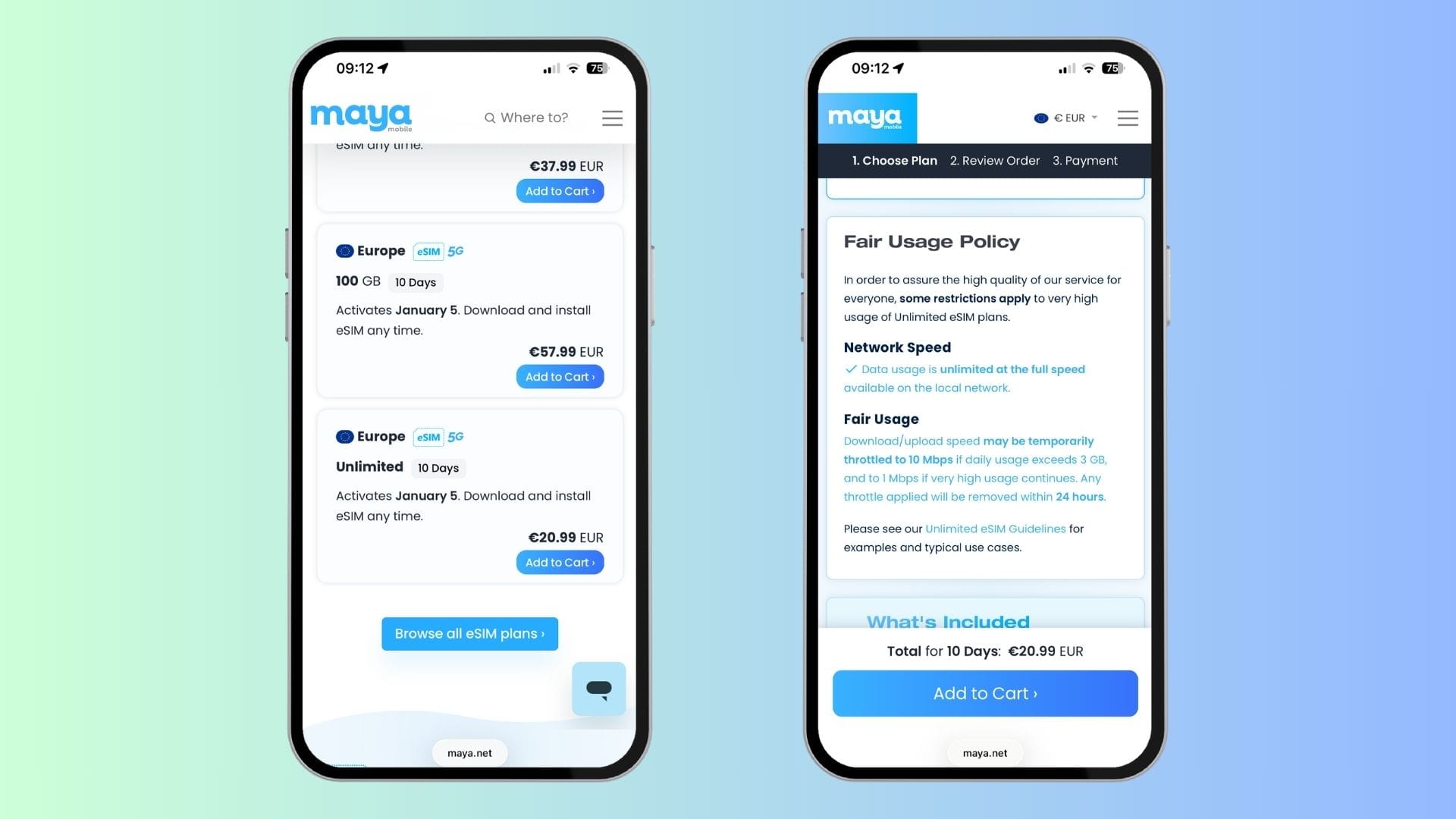
Many European travel eSIMs advertise “unlimited data”, but what they actually offer is:
- A fixed amount of high-speed data per day, often around a few gigabytes
- Throttling to much lower speeds after that
- A reset after 24 hours
You are not cut off. The connection remains active for the duration of the plan. But high-speed capacity is rationed daily.
This is unlimited access, not unlimited performance.
Two kinds of limits
At this point, it helps to name the difference that is often left implicit.
There are two fundamentally different ways a plan can fail.
Throttling
- You stay online
- Speed drops, sometimes sharply
- Messaging and light browsing still work
- Video calls, uploads, or hotspot use become frustrating
Hard caps
- Full speed until the allowance is gone
- Then data stops
- Performance is predictable
- The moment of failure is not
Neither approach is objectively better. They optimise for different kinds of reassurance.
The psychology behind the choice
This is where the decision becomes less technical and more human.
A throttled “unlimited” plan reassures you that you will never be completely disconnected. Something will always work, even if it becomes slow.
A large capped bundle, say 100 GB for a trip, offers a different comfort. For many people, that amount is effectively unlimited. Until it suddenly is not.
The anxiety shifts:
- With throttling: Will this still be usable today?
- With caps: Will I hit zero at the wrong moment?
Interestingly, the throttled “unlimited” option is often cheaper. That only makes sense if you assume that many users will spend a significant part of their time at reduced speeds.
What happens when a cap is reached?
On most capped travel eSIMs, the behaviour is straightforward:
- Once the allowance is used, data stops
- You need to top up or buy a new plan
- Any remaining validity period becomes irrelevant
There is usually no slow fallback and no safety net. The line is clean.
This makes capped plans less forgiving, but also more honest. You know exactly what you are buying, and exactly where it ends.
So what does “unlimited” really mean?
In a European context, it tends to mean different things in different economic settings:
- At home: trust and statistical averaging
- While roaming: regulated volume limits
- On travel eSIMs: controlled speed over time
The word survives because it is legally defensible and psychologically comforting. But technically, unlimited always has edges.
The more useful questions are not whether something is really unlimited, but:
- Where is the limit?
- Is it a slowdown or a stop?
- And which one fits the way I actually use my phone?
Once those limits are visible, unlimited becomes less magical, but far more practical.


 Rob Hoeijmakers