
Making Content Ready for Intelligence
Unstructured content already holds the knowledge organisations rely on. The shift is learning how to reveal its structure so intelligent systems can use it.


A short exchange on LinkedIn about llms.txt led me to meet Pieter Versloot from Plate. I expected a technical discussion about AI crawling behaviour. Instead, we ended up talking about the foundations of organisational memory.
How symbolic structure can emerge from the unstructured content organisations already produce every day.
That is the quiet breakthrough. Content doesn’t need to be forced into formal structure when it is created. The structure can be discovered. And once it is discovered, it can be maintained.
Meanwhile, publishing still serves humans. We write pages. We measure reach. That hasn’t changed. What has changed is who reads first. Language models digest our content before most people do. They internalise what we publish, form assumptions, and reuse that knowledge elsewhere.
Content behaves like knowledge. We still treat it like decoration.
 Rob Hoeijmakers
Fragmentation as the default
As organisations scale, content spreads and slowly drifts apart.
Small copies accumulate. Facts diverge. Metadata becomes optional.
Editors continue. Machines continue.
Trust becomes fragile.
This is not a CMS problem. It is a knowledge integrity problem.
A conversation that connected the dots
Pieter approached this from the inside: a decade of building websites and CMS for large organisations. He saw publishing succeed at the surface while coherence failed underneath.
Plate’s response is not to replace systems. It is to reveal, repair and sustain what organisations already know, but cannot easily see.
The layer that sees
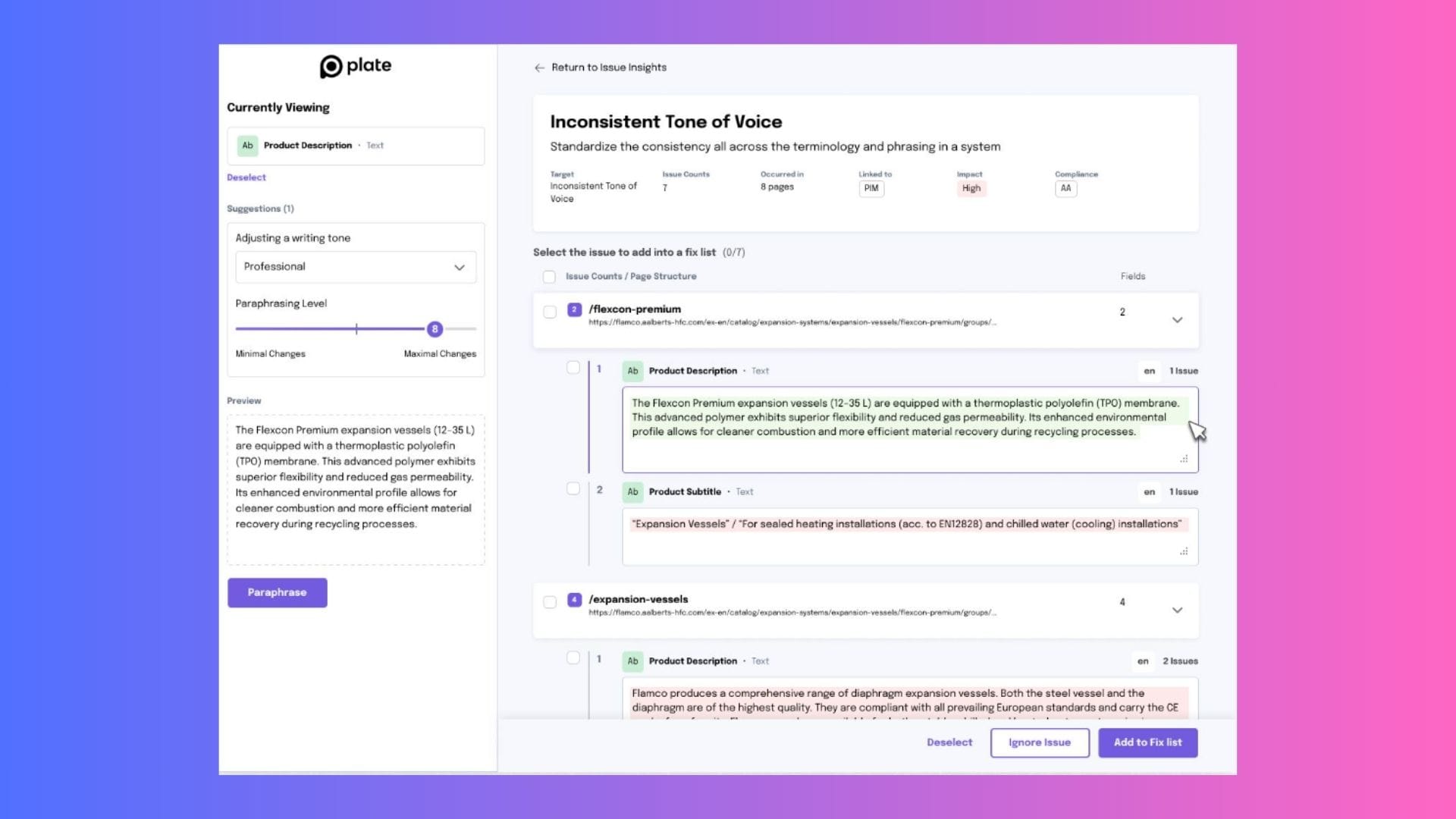
At the centre of Plate Delta is CAS, the Content Analysis Service.
It reads content across systems, notices patterns and detects gaps.
Repeated product names. Inconsistent facts. Duplicated assets. Tone shift across teams. Metadata that is present in one place and missing in another.
Machines do the auditing humans cannot scale.
“With Plate Delta, structure doesn’t come first, it follows the work. CAS reads how content is actually used and guides from real patterns, not preset rules. Structure stops feeling forced and starts doing its job.”
— Pieter Versloot
Structure emerges from reality rather than being mandated.
The layer that repairs and maintains
The Content Engineering Layer (CEL) then reinforces what CAS discovers.
It creates a continuous loop:
• detect divergence
• align to a shared model
• prevent new drift
Editors remain expressive. Systems remain flexible.
Coherence becomes infrastructural rather than personal.
“The bigger an organization gets, the more content rules drift into people’s heads or scattered tools. That doesn’t scale. You end up with systems that lock everyone down or with shadow IT that fuels chaos. Only a central, intelligent content base breaks that cycle.”
— Pieter Versloot
CEL does not centralise content.
It centralises alignment.
Where symbolic structure takes shape
Unstructured writing is how humans think.
From it, CAS and CEL surface:
• entities
• attributes
• relationships
• contexts and constraints
What begins as text becomes symbolic knowledge.
A knowledge graph forms organically out of use.
Meaning becomes computable.
AI can draw from a reliable foundation.
 Rob Hoeijmakers
What this enables
A continuously maintained knowledge base improves daily work:
• faster editing, less hunting for inconsistencies
• reliable product information everywhere
• multilingual content aligned over time
• AI assistants grounded in verified truth
Structure becomes governance.
Consistency becomes trust.
Plate’s product set
Three components, one intelligence loop:
- Content Health Audit
See what is broken - CEL: Content Engineering Layer
Repair and maintain alignment - Plate CMS (Delta)
Publish without reintroducing chaos
Machines reveal. Machines align.
Humans stay in control.
Looking ahead
Content becomes knowledge when it stays aligned over time.
And that memory becomes the internal logic on which every service relies.
If you recognise that your content is working against you as much as for you, there might be a better foundation available.
I’m not affiliated. Just impressed. And curious where this thinking leads.


 Rob Hoeijmakers
 Rob Hoeijmakers