
Looking Past the Model
ChatGPT Work and Kimi K3 made me look beyond the engine. Increasingly, the meaningful product may be the environment in which a model can actually work.


A few days ago, I updated ChatGPT on an older Intel Mac. I had been looking for Codex. Instead, I found myself with ChatGPT Classic, ChatGPT Work and ChatGPT Codex.
For a moment, it looked like product confusion. Then I started using it.
What surprised me was not a sudden improvement in the model. It was everything around it: local files, connected services, document creation, projects and longer-running tasks. Codex brought the same kind of agency into code and repositories.
I had seen much of this in Claude. Its integrations and MCP servers made it feel situated inside my working environment. ChatGPT now appears to be catching up—not only as a model, but as a product.
Model release, product release
That distinction may explain why I almost missed the significance of OpenAI’s July update.
OpenAI’s announcement on 9 July makes the product nature explicit. It introduced ChatGPT Work as an agent that can act across apps and files, stay with longer projects and create finished materials. The updated desktop application brought Chat, Work and Codex together.
OpenAI’s migration guidance also explains the slightly confusing result I encountered: the previous desktop app was renamed ChatGPT Classic while the new application arrived alongside it. Its system requirements confirm support for both Apple Silicon and Intel processors.
A week later, Kimi K3 received the kind of attention AI releases usually receive. It had the stronger public story: a very large Chinese model, presented as open, with impressive benchmark results and an obvious geopolitical angle.
The contrast made me wonder whether we are watching the wrong layer. We notice a new engine immediately. A change to the vehicle around it can pass almost quietly.
OpenAI’s update was presented as a product release. The public conversation around Kimi K3 concentrated mainly on the model. Both changes reach further into the stack than those descriptions suggest.
The harness around the model
I previously wrote about the word harness. I resisted it because a harness sounds like restraint, while the infrastructure around an AI model also equips it.
I understand the term better now. A useful AI system needs both.
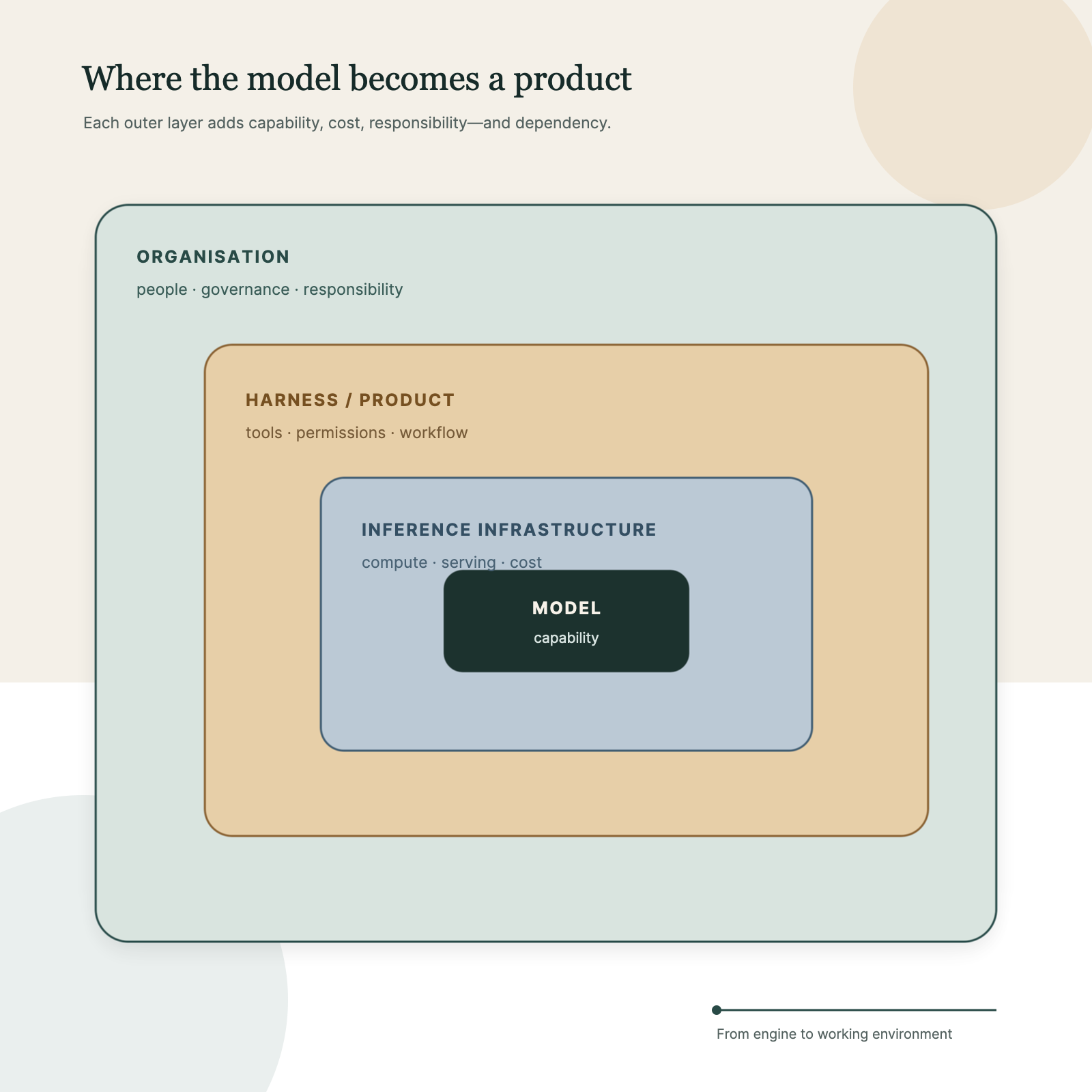
Files, browsers, memory, connectors and code execution give a model somewhere to work. Permissions, sandboxes and approval steps determine where it must stop. The model provides capability; the harness turns that capability into something that can participate in an organisation.
This also refines something I was trying to express in Why I Keep Choosing Proprietary Products. I may have been comparing different layers. Open source can provide an excellent engine. A product takes responsibility for assembling the engine, tools, interface, permissions and support into a usable whole.
That does not make proprietary products inherently better. It does mean that “open AI” is too broad a description. Open weights are not the same thing as an open working environment.
This is not an outside observation
I should also be clear about my own position. Through Schmuki, we work closely with Wiseware, a private AI platform used with organisations in education, government, academia and healthcare.
In one sense, Wiseware occupies some of the same territory as ChatGPT and Claude. It connects models to knowledge, tools and people. But its priorities and target groups are different: controlled organisational environments, privacy, governance, European requirements and collaboration around implementation.
So I am not looking at this only as a commentator. I work with this product layer, and I see how quickly the conversation changes once AI enters an organisation. The question is no longer simply which model performs best. It becomes: what may it access, where does the data go, who remains responsible, and how do people actually work with it?
Kimi has a harness too
Kimi complicates the story in a useful way. Moonshot has not released only a model. It also offers Kimi Work, a desktop agent, and Kimi Code.
But the layers still matter. Kimi K3’s weights are the open part of the story. Kimi Code is open source. The complete Kimi Work environment is a proprietary product.
An analysis by Azeem Azhar and Hannah Petrovic in Exponential View adds an important layer to this. The weights may be available, but serving a model of this size still requires expensive infrastructure. Open weights can nevertheless change the economics for cloud providers and give enterprise buyers leverage, even when those enterprises never run the model themselves.
They also point to the other side of the product layer: switching costs. Integrations, workflows, training and support make a product useful, but those complementary investments also make it harder to leave. The harness does not only turn a model into a product. It can become the place where dependency accumulates.
You may therefore be able to obtain the engine without receiving the whole vehicle. That is not necessarily a criticism. It may simply show where even an open-model company expects the lasting relationship with users to sit.
Perhaps this is why the latest ChatGPT update felt bigger to me than its public reception suggested. Frontier models are expensive, but the products built around them can be remarkably accessible. Conversely, a model that is free to download can become expensive once an organisation must supply its own infrastructure, integrations, security and governance.
I am not ready to say that the model no longer matters. A weak engine does not become useful because it has an elegant interface. But once several models are capable enough, the surrounding environment may decide which one becomes part of real work.
The model attracts attention. The harness determines what can be done with it.
Increasingly, that is where my own attention—and my work—sits.
Read more
- The Workspace You Already Have — on the powerful but largely ungoverned AI layer many knowledge workers have assembled for themselves.
- The €60,000 LLM Well — on what independence from hosted AI infrastructure can actually cost.
- The Layer AI Is Moving Into Now — on AI moving from individual tasks into organisational coordination.