The Workspace Advantage: Google’s Quiet Lead in the AI Shift
The real AI race is not model vs model, but who owns the environment where work lives. Gemini 3 gives Google a quiet but strategic advantage.


The centre of gravity is starting to move
For most of my personal thinking, I still reach for ChatGPT. It feels quick, intuitive and multilingual in a way that supports my habits. Yet, as more of my work sits inside Google Workspace, there is a quiet shift. Gemini 3 makes it difficult to ignore Google’s position. Not because their app is delightful. Because their AI is embedding itself into the substrate of work.
Two different kinds of intelligence
I am not a financial analyst. My interest is how the product fits into everyday life, and what incentives shape its evolution. Still, some basic facts matter.
Google owns the environments where billions collaborate and store knowledge: mail, documents, identity and devices. They have their own chips, distribution and deep access to organisational context. OpenAI, despite exceptional models, does not have that infrastructure. It buys compute and earns integration deal by deal.
This leads to two forms of intelligence.
• One stays close to the human mind.
• The other sits inside the systems that run organisations.
Gemini 3 highlights the distinction.


How I work today: power with friction
I already use ChatGPT Team with connectors. It can read documents in my Drive, search my Gmail, and extract the context I need. In principle, I have access to the information layer. In practice, there is still a gap between understanding and action.
I can draft in ChatGPT. I can check facts inside my files. But replying to email still means copying and pasting. Creating or updating documents requires manual steps and permission juggling. The intelligence knows the context, yet remains slightly outside the workflow.
It feels as if my thinking lives in one place, and my work lives in another.
 Rob Hoeijmakers
From helpful advice to actual execution
When AI sits directly inside the tools we use, it does more than understand. It can act. It can send the message, schedule the meeting, update the document, move the work forward. That makes it more influential than a good conversation on the side.
It may still feel awkward at the surface. The interface is not yet elegant. But the real power lies underneath, in the systems of permissions, records and coordination. Once intelligence controls those layers, it stops being optional.
Google’s own dilemma
Search still prints money. The model depends on sending users out into the web, and being paid for those journeys. A conversational AI gives the answer directly. No journey, no revenue.
Google must decide whether to protect the past or build the future fully. It cannot do both without cost.
 Rob Hoeijmakers
Our dilemma too: the shape of dependency
With ChatGPT, my dependency feels like a dependency on an engine. Painful to swap out, but not impossible. With Google, the dependency goes deeper. Knowledge, communication and archives accumulate inside one ecosystem. Most users will never extract them again.
That is not an accident. It is part of the value proposition.
Google can bundle intelligence into what organisations already pay for. Gemini appeared in my Workspace account without debate. ChatGPT, by contrast, is an additional subscription. Cost alone shapes choices.
Why Europe should pay attention
When intelligence becomes a utility, the owners of distribution gain power over identity, pace and rules. Convenience today can be structural dependence tomorrow. Sovereignty is no longer only about where data lives. It is about who mediates judgment.
Two trusted relationships
I trust ChatGPT more as a companion.
I trust Google more to handle the messy details of work.
Which trust will matter more. The one guiding our thinking, or the one controlling our tools.
A beginning, not an end
Gemini 3 marks a deeper entanglement between AI and the environments where decisions are made. The important question is no longer which model is best, but who we allow to sit at the centre of our working lives, and how easily we can move on if we decide to take that centre back.
P.s. Where will the price for all this go? I find this an interesting and thought provoking view:
Everyone thinks Google will drop the price of Gemini 3.0 to zero because their chips (TPUs) are so cheap.
— Carlos E. Perez (@IntuitMachine) November 22, 2025
I ran the game theory on this, and I think we have it backwards.
Google actually has the strongest incentive to keep AI expensive. Here’s the trap. 🧵
1/ The "Obvious"…
 Azeem Azhar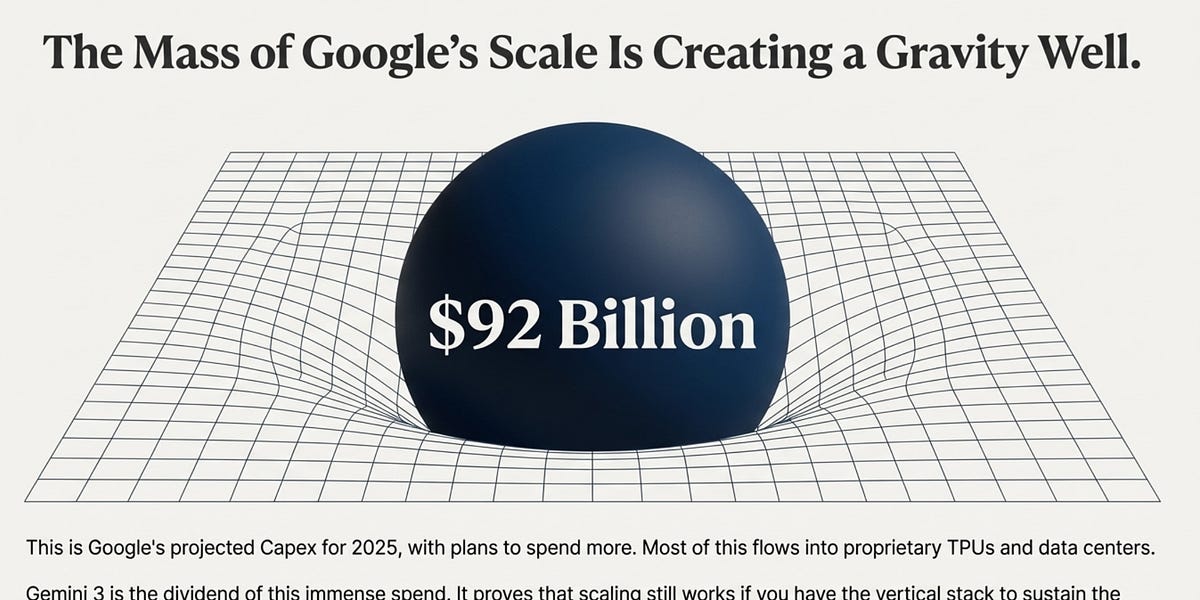




 Dani
Dani