Finding My Place in Europe’s AI Future
Policy is loud, practice is quiet. Europe’s future will be shaped by those who build working systems. Here is where I choose to look.

Over the past year I have been circling the same question from different angles:
what is the actual playing field in which I work when I build AI systems in Europe.
Not just in a narrow, technical sense, but politically, economically and geopolitically.
Who sets the rules. Where does the money come from. What is Europe trying to become.
When the Draghi report on European competitiveness appeared, I read it and felt both alarmed and energised. It was a signal that the ground under our work is shifting. More recently I spent time with two substantial pieces: Europe in the Age of AI and The Constitution of Innovation. Together they forced me to ask a simple question:
where do my own views sit in this landscape, and what does that mean for my company and the organisations I advise.
This is a developing arena for me. My perspective will evolve. But the topic became too important to treat as background noise. The work we do is shaped by forces that reach far beyond project scopes and product roadmaps.
When I write Europe here, I mean the Union and the wider ecosystem of companies, institutions and regional networks that give it real capability.
Quick takeaways
- Europe’s AI debate is now about power, security and the economy.
- Fragmentation, hesitation and underinvestment slow us down.
- My focus is shifting toward local pioneers and practical capability building.
Why this became urgent for me
I run an agency that designs and implements AI-driven tools for healthcare, public services and mid-sized companies. These organisations operate under European rules and budgets, and their ability to modernise is shaped by Europe’s strategic choices.
Another element matters too. Public attitudes toward technology in Europe are oddly ambivalent. It is not fear or moral outrage, but a quiet scepticism. As if digitisation is something that happens elsewhere and mostly brings inconvenience.
The Blair report, Europe in the Age of AI, confirms this intuition: digitalisation is not a priority for European voters, and innovation and AI consistently rank near the bottom of topics citizens want the EU to focus on. This creates a political environment where urgency is low and hesitation feels safe.
That makes it even more important to understand the terrain: what is pulling us forward and what is holding us back.
Two lenses on Europe’s AI future
One text, Europe in the Age of AI, frames AI as a geopolitical turning point. Technological capability is presented as a requirement for security, prosperity and democratic confidence. It calls for political leadership, serious investment in compute and energy, and a more coherent narrative around technology in daily life.
The other, The Constitution of Innovation, focuses on economic mechanics. It argues that the Union’s prosperity engine has stalled: the internal market remains incomplete, regulation piles up, incumbents are protected and risk-taking suffers. The answer is to restore economic dynamism, with fewer barriers and faster scaling across borders.
 Luis Garicano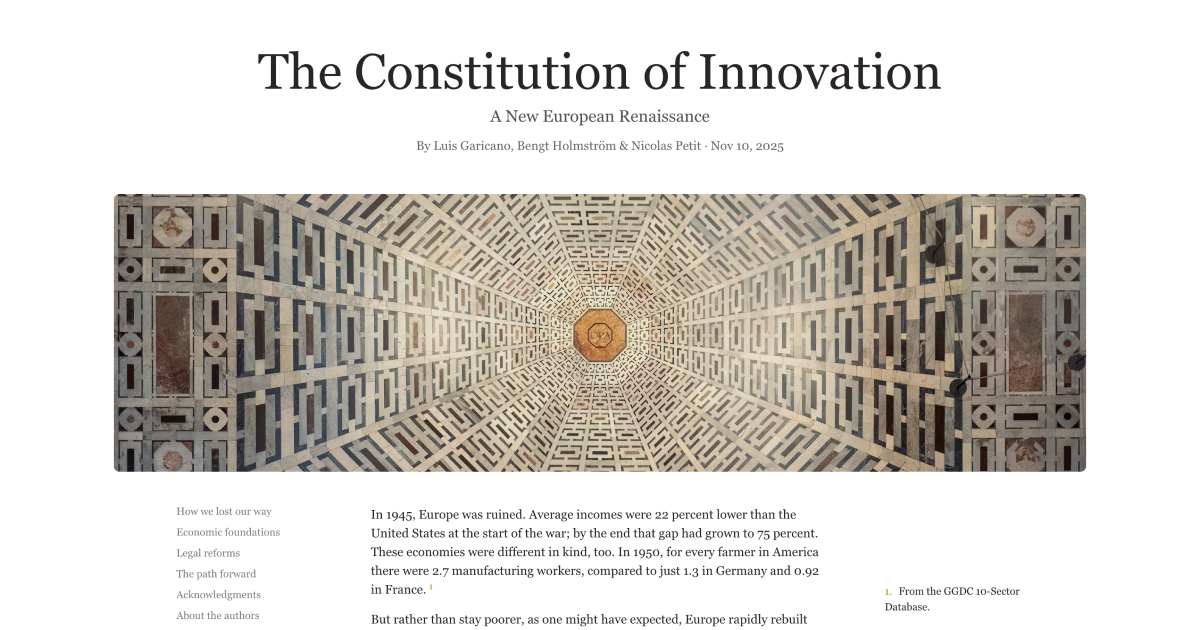
One starts from politics and security. The other from markets and law. Yet they strike the same nerves.
Where they agree
- Fragmentation is the central obstacle.
- Underinvestment leaves Europe consuming more than it creates.
- Hesitation preserves the status quo at the expense of future capacity.
- Sovereignty is about leverage and capability, not isolation.
Reports have been diagnosing these weaknesses for years. Execution remains thin.
The field where I actually play
My work sits far from Brussels. It lives in:
- a health organisation where front-line staff need instant access to procedural knowledge
- a social-care team trying to manage complex decisions with limited time
- a business struggling to align its website, data and customer workflows with AI-driven search and support
Recently, I worked with a social-care organisation that introduced a lightweight conversational system to support case workers. It did not transform everything at once, but it freed time, improved clarity, and gave the team confidence to take the next step.
These are not prototypes. They are real performance improvements, realised cautiously and under constraints.
They also reveal something hopeful:
- there is strong local ingenuity
- European values like privacy and dignity can be translated into practical systems
- when the basics are in place, AI can improve everyday institutions without breaking what people trust
This is why I look beyond continental blueprints and toward local pioneers: places where capability already exists and could scale if given room.
One idea in the The Constitution of Innovation caught my attention: a proposed “28th regime” for companies that want to grow across the EU. Instead of navigating 27 different national corporate rules, firms could opt into a single European legal framework, fully digital and directly connected to the internal market.
It is presented as a way to turn Europe’s scale into actual innovation power. Still early, still debated, but it feels like a concrete step worth examining if we want Europe to remain competitive in AI and beyond.
The 28th regime as a structural escape hatch
Europe’s single market is still mediated by 27 corporate systems. A company that wants to operate across borders must translate itself into each national regime. It scatters energy. It favours remaining small.
The “28th regime” pushes in the opposite direction. Instead of harmonising everything through compromise, it offers an optional EU-level framework that founders can adopt from the start. One legal identity capable of expanding across the Union without continual reinvention.
This shapes how capital flows, how talent moves, how IP is protected, and how quickly organisations can reach European scale. It is part of the foundation on which a confident digital economy must rest.
A coalition of European founders and investors is already campaigning for such a structure. One central EU registry. One set of investment documents. Stock options that work everywhere in the Union. A practical attempt to turn the 28th regime from concept into operating reality. A structure like this would not solve everything. But it would remove one of the quiet constraints that keep European innovation fragmented, localised, hesitant to grow.
A working direction
Trying to locate myself in this landscape, a direction emerges that is both realistic and ambitious. These are the places where capability can grow: grounded commitments that help institutions move from caution to confidence.
- Start from existing strengths
Focus on sectors with data, expertise and strategic value: healthcare, public administration, industrial automation. - Let pioneers lead and remove their barriers quickly
Scale what works across borders. Use practice to guide policy. - Think sovereignty as interdependence with leverage
Control what matters. Stay open where it benefits citizens and industry. - Tie regulation to delivery
Judge rules by whether they enable responsible deployment. - Accept creative destruction
Make space for new entrants and new approaches.
What this means for my work
This direction reshapes the questions I ask and the advice I give.
- Track not only technology, but energy policy, capital flows and regulatory change.
- Design for cross-border reuse, not single-site dependency.
- Be explicit that AI adoption is part of a wider European shift toward resilience and competitiveness.
The micro and macro are not separate worlds. They meet in the systems we build for real use.
Closing
Europe is not one actor. It is a layered field where policy, national governments, companies and research networks shape the possible together. The future will not emerge from directives alone, but from places where people build new capabilities and learn to trust their own momentum.
This map helps me decide where I can contribute to that fabric. Local strength that can scale when it works. Public actors that know when to support and when to step aside.
A Europe that builds from what is already strong. A Europe that trusts its pioneers. A Europe that enables Europeans to move.

 Rob Hoeijmakers
 Exponential View
 Rob Hoeijmakers