
Digital Europe in Two Acts: DSA and DMA
Europe’s DSA and DMA work in tandem. One governs digital content, the other digital competition. Together they form the EU’s Digital Services Package.

Europe's two flagship regulations, the Digital Services Act (DSA) and the Digital Markets Act (DMA), are often mentioned in the same breath. That’s no coincidence. Though they serve different purposes, they were proposed together and form what the European Commission calls the Digital Services Package: a coordinated regulatory effort to make the internet both safer and fairer.
Yet even close observers may struggle to see how they interact. They target the same tech giants, use similar tools, and entered into force within months of each other. But one focuses on services, the other on markets. Understanding this distinction — and their complementarity — is key to seeing the deeper structure of Europe's digital rulebook.
Twin Pillars of the Digital Services Package
The DSA and DMA function as twin pillars of EU digital regulation:
- DSA = Digital Services Act → regulates how digital services interact with users
- DMA = Digital Markets Act → regulates how digital platforms compete and behave in the market
In this sense, they address two different domains:
speech and safety (DSA) vs. competition and structure (DMA).
Together, they redefine the conditions under which digital platforms can operate in Europe.
What the DSA Does: Governing the Digital Public Square
The DSA applies broadly to digital intermediaries — from hosting providers to online marketplaces and very large platforms.
It focuses on:
- the moderation of illegal content
- ad transparency
- algorithmic accountability
- risk management for systemic harms
The goal is to uphold fundamental rights, reduce harm, and make platforms more transparent and responsible.
In short: it regulates the informational role of platforms in society.
What the DMA Does: Rebalancing Digital Market Power
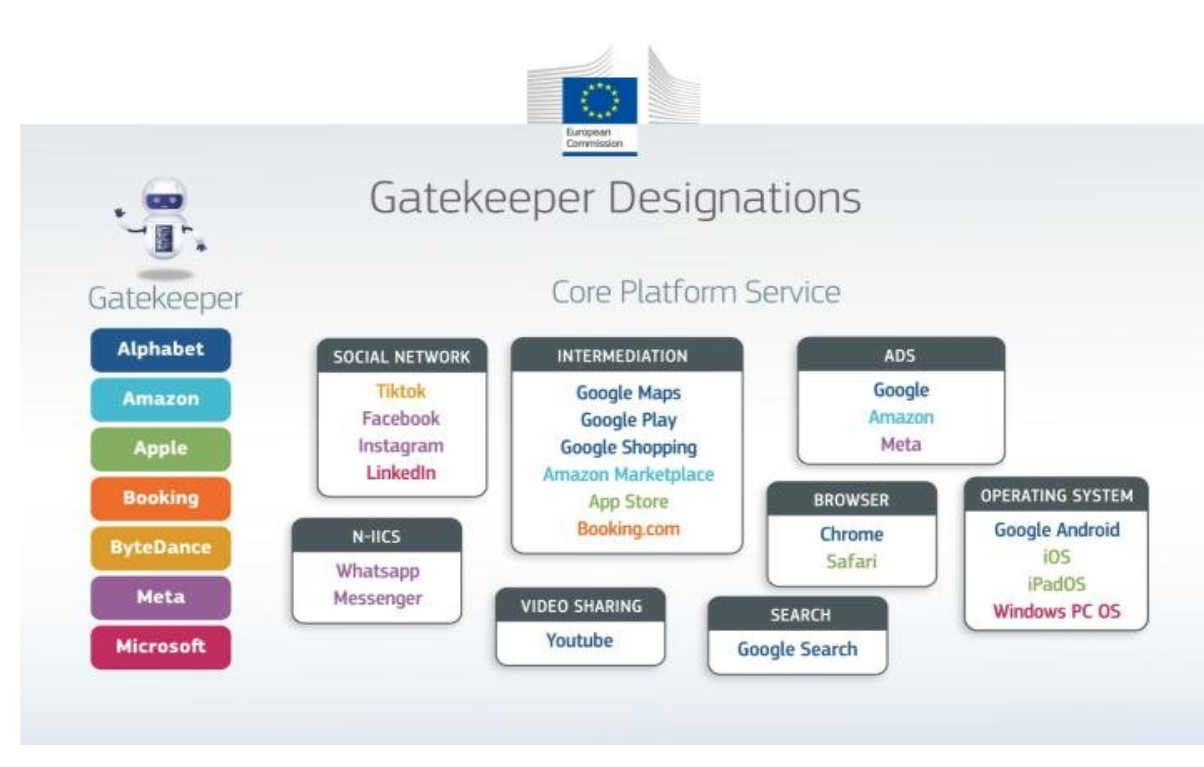
The DMA targets a small group of gatekeepers — platforms with entrenched power that serve as critical intermediaries between businesses and users.
It imposes obligations such as:
- no self-preferencing
- no bundling or forced sign-ins
- mandatory interoperability
- data separation between services
Its aim is to ensure contestability in digital markets, preventing dominant platforms from abusing their position.
In short: it regulates the structural power of platforms in the economy.
Where They Overlap
While their scopes differ, the DSA and DMA overlap in four key areas:
- Targeting the same tech giants
Most platforms designated as gatekeepers under the DMA are also very large online platforms (VLOPs) under the DSA. These include Alphabet (Google), Meta, Amazon, Apple, ByteDance (TikTok), and Microsoft. - Transparency and disclosure obligations
Both Acts require platforms to be more open about their internal mechanisms — whether it's content recommendation (DSA) or ranking practices (DMA). - User empowerment
The DSA gives users more control over how their data is used and how content is presented. The DMA gives users and business users more freedom to choose services, port data, and uninstall apps. - Enforcement and oversight
The European Commission oversees gatekeeper compliance under the DMA, while Digital Services Coordinators (with Commission support) enforce the DSA. There’s growing coordination between the two.
A Complementary Logic
The Digital Services Package doesn’t treat digital platforms as a monolith. Instead, it recognises two dimensions of their power:
- As public spaces, where people exchange information, form opinions, and exercise rights
- As market gatekeepers, controlling access, infrastructure, and innovation
Regulating both dimensions requires different tools — but a shared philosophy: that the digital space must be open, accountable, and subject to the rule of law.

Why It Matters
The overlap between content, data, and competition is not just a legal tangle — it’s a structural reality. For example:
- A platform might demote a competitor’s product (DMA issue) under the guise of content moderation (DSA issue).
- A business may face platform exclusion that affects both speech rights and economic opportunity.
Without addressing both fronts, regulation would be incomplete.
A Coherent Framework, If You Know Where to Look
Understanding the DSA and DMA as a regulatory bundle — Europe’s Digital Services Package — helps clarify the evolving digital landscape.
– DSA governs how platforms treat users and content– DMA governs how platforms treat competitors and markets
Seen together, they signal a shift: from laissez-faire digital exceptionalism to a structured digital constitutionalism — one that puts both freedom and fairness at the heart of Europe’s online future.
 Rob Hoeijmakers
 Rob Hoeijmakers
 Rob Hoeijmakers
 Rob Hoeijmakers