Structuring Knowledge with Obsidian
Discovering how Obsidian, Markdown and a light taxonomy can reveal the hidden structure of five years of writing and open a path toward knowledge engineering.


Obsidian is a simple text notebook that lets you connect individual notes and then see those connections as a map. That small shift changed how I understood the knowledge I had gathered over time, and it also changed how I could use it.
Much of my work involves building conversational and agentic AI systems, and these systems depend on well-structured sources. Once my own material became a network rather than a sequence, it became far more suitable for that purpose.
If you work with notes, research or any growing body of text, this approach may help you see relationships that usually remain hidden and prepare your material for more advanced uses. This piece focuses on the core idea: how non-linear knowledge can be structured, visualised and reused for symbolic or hybrid AI.
Knowledge Is Rarely Linear
We often store information as if it were linear: in folders, lists, or chronological archives. But ideas rarely develop that way. They branch, overlap and return. Understanding a domain requires seeing those relationships rather than the order in which material happened to be written.
The first step is to treat text not as a sequence but as a field of connections.
A Text-Based Foundation
Working entirely with plain text (markdown to be precise) keeps the material flexible. It can be reshaped, linked and repurposed without being locked into a particular system. When moved into Obsidian, each piece of text becomes a node that can be connected to others. The structure emerges from the links rather than from an imposed hierarchy.
This simplicity is essential for later use in symbolic or hybrid AI systems.
Visualising Structure
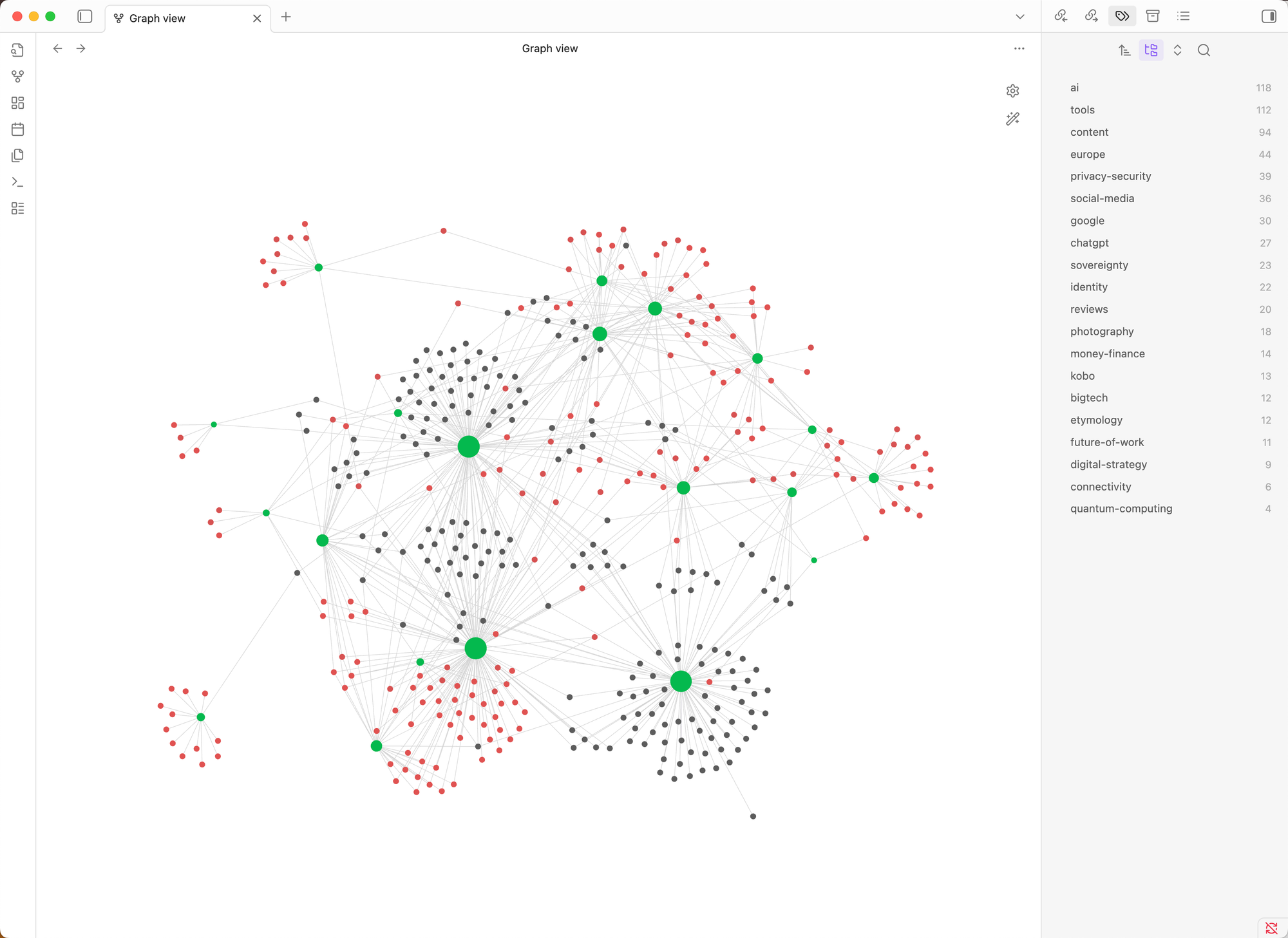
Obsidian’s graph view does not create meaning, but it reveals how meaning is distributed. Dense clusters show where ideas reinforce each other. Sparse areas show where thinking is thin or disconnected. Connections that were intuitive become visible. Gaps that were unnoticed become clear.
Visualisation here serves a practical purpose: it prepares the ground for knowledge retrieval.
From Structure to Reuse in AI
Symbolic and hybrid AI systems operate best when they have access to structured knowledge. A linked set of texts, even at the page level, is already more usable than a flat archive. An AI agent can navigate the map, follow connections and retrieve material with more precision than free text alone allows.
This is the real benefit: once knowledge is structured and visualised, it becomes reusable.
A Case Study: My Own Archive
I discovered this by using my blog (in Ghost) as a test case. Hundreds of posts spread across years became a network once they were in Obsidian. Themes surfaced. Outliers appeared. The structure became workable rather than opaque.
But the blog is only an example. The method applies equally to research notes, project documentation or any long-running collection of text.
Looking Ahead
Looking ahead, the next step is finer granularity: moving from pages to concepts, where a true knowledge graph begins to form and where symbolic AI can work with greater precision.
But even at the current level, Obsidian has proven to be a remarkably effective instrument. It keeps knowledge close to plain text, makes structure visible and leaves room for growth.
For many kinds of work, it may be one of the most practical ways to shape and reuse knowledge, both for human thinking and for AI systems.

 Rob Hoeijmakers
 Rob Hoeijmakers