
From lab to fab needs more than a fund
Europe does not merely lack capital. It lacks the institutional machinery for turning research, young companies and industrial ambition into scale.


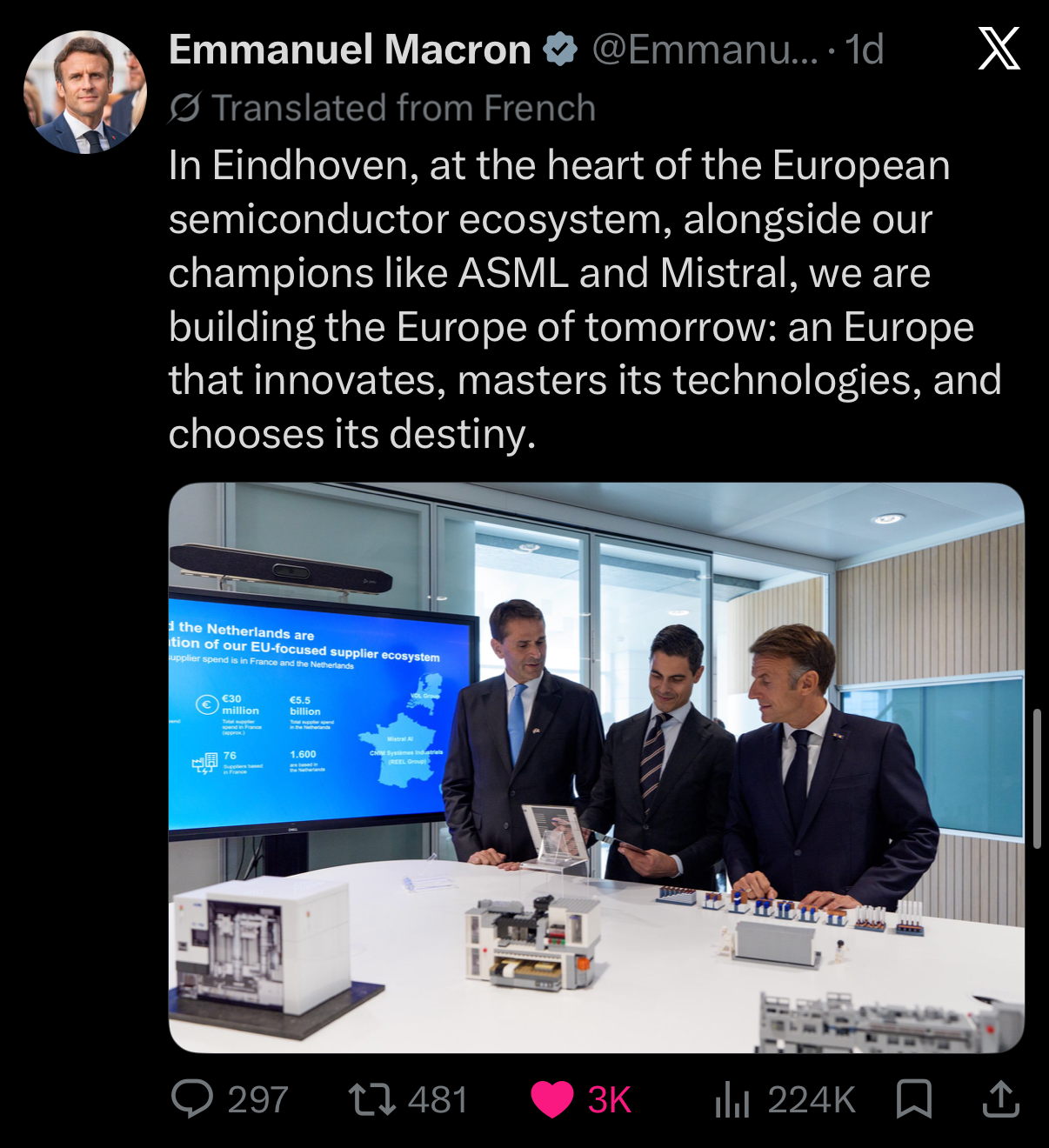
This week, Emmanuel Macron and Dutch prime minister Rob Jetten visited ASML in Veldhoven. The French delegation included Mistral AI, making the setting unusually apt: a French AI company visiting the Dutch manufacturer of the machines needed to produce the most advanced chips.
The resulting Franco-Dutch statement was unusually direct about the geopolitical stakes. Technological leadership, it said, translates into economic power, political influence and military capability. Europe therefore needs to connect AI, computing, semiconductors, photonics and quantum technology into something resembling an industrial system.
One phrase caught my attention. Europe needs seamless funding “from lab to fab”.
A day later, NOS reported that the Dutch government is accelerating plans for a national investment institution, backed by an initial €3.3 billion. Its purpose would be to help innovative companies grow and keep more of them in the Netherlands.
Seen separately, these are two rather different news stories: a diplomatic technology visit and another Dutch financing initiative. Together, they helped me understand a missing part of the European technology debate.
More than another pot of money
I have been circling this problem in my writing about deep tech.
In The Deeptech Dilemma, I looked at Europe’s difficulty in turning excellent science into large technology companies. In my conversation with Alain le Loux about investing in atoms, the central problem was patient capital. Deep-tech companies need large amounts of money, specialist knowledge and considerably more time than a software start-up. More recently, I found myself making a similar argument about AI compute: once land, electricity, data centres and chips enter the picture, this starts looking less like conventional venture capital and more like infrastructure finance.
My assumption was that Europe simply did not have enough capital of the right kind.
That remains partly true. But the Dutch investment-bank discussion points to a more specific problem. Europe does not merely lack money. It lacks enough institutional machinery for combining different kinds of money and staying with a technology as it moves from research to start-up, factory and industrial infrastructure.
The Netherlands already has public financiers, regional development agencies, subsidies, venture funds, a Deep Tech Fund and access to European programmes. So my first reaction to the idea of a new national institution was fairly obvious: why add another fund?
The important distinction is that it is not supposed to be just another fund.
A fund is, in simplified terms, a bounded pot of money with a particular mandate. It invests until that money has been allocated. A promotional investment bank can operate funds, but it can also provide loans, guarantees and equity, take different positions within a financing package and, depending on its structure, raise additional capital against its balance sheet.
It can also do something less visible but perhaps equally important: develop projects, combine financiers and absorb precisely the part of the risk that prevents others from participating.
That matters because the financing problem changes as a company grows. A research grant may help prove the science. Venture capital can finance an early company. But building a semiconductor facility, biotechnology production line or large compute campus may require hundreds of millions or several billions. At that point, neither a normal start-up fund nor a commercial bank is necessarily equipped to carry the project.
A public investment institution can provide the first layer, a guarantee or a long-term loan. That can make the risk acceptable to banks, insurers, pension funds and European institutions. Public capital is then not only spent. It is used to organise a larger investment.
France as a reference case
Germany’s KfW is the classic European example of a promotional bank with a very large balance sheet and extensive capital-market financing. It demonstrates the financial difference between a bank and a collection of funds.
For the technology question, however, France may be the more interesting reference case.
France created Bpifrance in 2012 by combining three existing public financing organisations. It brought credit, guarantees, innovation financing, direct investment, investment in private funds, export support and advisory services into one institution.
That is different from making one large pot of public money. France centralised the capacity to translate political priorities into financial instruments, investment programmes and relationships with companies.
There is some evidence that this has helped develop the market around it. According to an OECD assessment, Bpifrance invested €4 billion directly in almost 450 companies between 2013 and 2022. It invested another €5 billion in 160 private venture-capital funds. Those funds ultimately raised €27 billion, implying that every euro committed by Bpifrance was accompanied by considerably more capital from elsewhere.
An even more interesting detail is that Bpifrance’s average share in its partner funds declined as those funds became larger. That is what a successful public intervention should ideally do: help create a market rather than permanently replace one.
France has not solved European innovation. It is not the continent’s uncontested technology leader, and a powerful state institution brings obvious risks of political interference, complexity and crowding out private investors.
Still, something coherent is visible. France has combined research institutions, industrial policy, public investment, procurement and political promotion around technologies such as AI, nuclear energy, aerospace and defence. Mistral’s presence at ASML fits that pattern. It links a French attempt to build an AI champion with the Dutch industrial capability on which the entire advanced chip industry depends.
My hunch is that France’s centralising tradition helps here. This is difficult to prove as a simple causal claim, and centralisation can produce expensive failures as easily as successful national projects. But it does give the country a capacity that Europe often lacks: the ability to choose a direction and then align institutions, capital and political attention behind it.
Bpifrance is not the sole explanation for France’s current technology momentum. It is better understood as part of the machinery that makes such momentum possible.
 Helen O’Reilly-Durand
National institutions inside a European system
This still leaves the question of why the Netherlands needs its own institution. Why not leave this to the European Investment Bank?
The answer appears to be that the two levels perform different roles.
The EIB provides continental scale, European risk-sharing and access to large pools of capital. National institutions possess local knowledge, find and prepare projects, work with smaller companies and represent national industrial interests. The EIB itself describes these institutions as intermediaries, co-investors and co-financiers that help difficult projects come to life.
A Dutch institution could therefore help a photonics company or biotechnology plant become investable, combine its own contribution with Dutch pension capital and then bring in the EIB or another European programme.
This is not necessarily economic nationalism. For the largest technologies, a purely national approach will be too small. But European financing cannot be organised entirely from Luxembourg or Brussels either. Someone still has to know the companies, understand the industrial ecosystem and build the project.
The emerging system is layered: national institutions originate and organise; European institutions add scale and risk-sharing; private capital supplies much of the eventual investment.
That system remains uneven. Germany has financial scale. France has built a more integrated innovation institution. The Netherlands is now trying to add a layer it has so far lacked. At European level, new scale-up and competitiveness funds are intended to connect these national efforts.
None of this guarantees good investments. A national institution can just as easily become a politically convenient collection of programmes. The decisive question is therefore not whether the Netherlands creates another organisation with several billion euros. It is whether that organisation gains the mandate, expertise, instruments and balance sheet to connect the pieces that already exist.
This is what I saw differently after putting the two news stories together. Capital is not merely a quantity. It has an architecture.
Europe’s problem has long been the discontinuity between its laboratories, its young companies and industrial production. The visit to ASML showed the outlines of a more coherent European technology system: French AI, Dutch semiconductor machinery, European demand and public-private investment.
The technology is not the only thing that must travel from lab to fab. The financing has to make the same journey.