
EU Inc.: A Lesson in How Europe Makes Its Laws
I followed Europe's plans for a common company framework with considerable interest. Then the national governments started negotiating. What happened next taught me something about how the European Union actually works.


EU Inc.: A Lesson in How Europe Makes Its Laws
I followed Europe's plans for a common company framework with considerable interest. Then the national governments started negotiating. What happened next taught me something about how the European Union actually works.
I've been trying to understand how the European Union actually works.
Not so much its institutions in the abstract, but how decisions are made. How does an idea become European law? Who gets to change it? And why does the result sometimes look so different from the original proposal?
It's a complicated process. Long, sometimes difficult to follow, and not particularly exciting to read about. But it affects almost everything we do, from running a business to developing technology, investing and working across borders.
So I've decided to take a closer look, using actual legislative proposals as examples.
EU Inc. turned out to be a particularly interesting one.
The promise of a European company
I've written about EU Inc. before, first when exploring the idea of a 28th regime, and later when the European Commission presented its proposal.
The idea appealed to me immediately.
Europe has a single market, but companies still operate within 27 different national legal systems. Establishing a company in the Netherlands is one thing. Expanding into Germany, France or Italy can introduce new legal requirements, administrative procedures and costs.
For a young company trying to grow, that fragmentation matters.
It is part of a larger European problem. We have excellent universities, researchers, engineers and entrepreneurs, but turning their work into companies that can grow across Europe remains difficult.
In 2024, Mario Draghi and Enrico Letta published influential reports examining Europe's competitiveness and the functioning of its single market. Both drew attention to the obstacles created by fragmentation.
One of the ideas that gained momentum was a common European company framework, often called the 28th regime.
Rather than replacing national systems, Europe would introduce an additional, optional framework. Entrepreneurs could choose to establish a company under common European rules.
On 18 March 2026, the European Commission presented its proposal: EU Inc.
The headline was attractive. Establish a company entirely online, within 48 hours, for no more than €100, without minimum share capital requirements.
But there was more to it than registration.
The proposal also addressed digital share transfers, financing, employee stock options, company administration and certain insolvency procedures.
The ambition was to make it easier not only to establish a company, but to operate, finance, grow and, when necessary, close one.
That distinction is important.
And then the Council got involved
When the Commission presented EU Inc., I followed the announcement with enthusiasm.
There was a proposal, considerable political support and an apparently clear direction. I assumed the next important step would be the European Parliament.
That wasn't entirely wrong, but I had overlooked something fundamental.
The Commission proposes European legislation. It does not enact it.
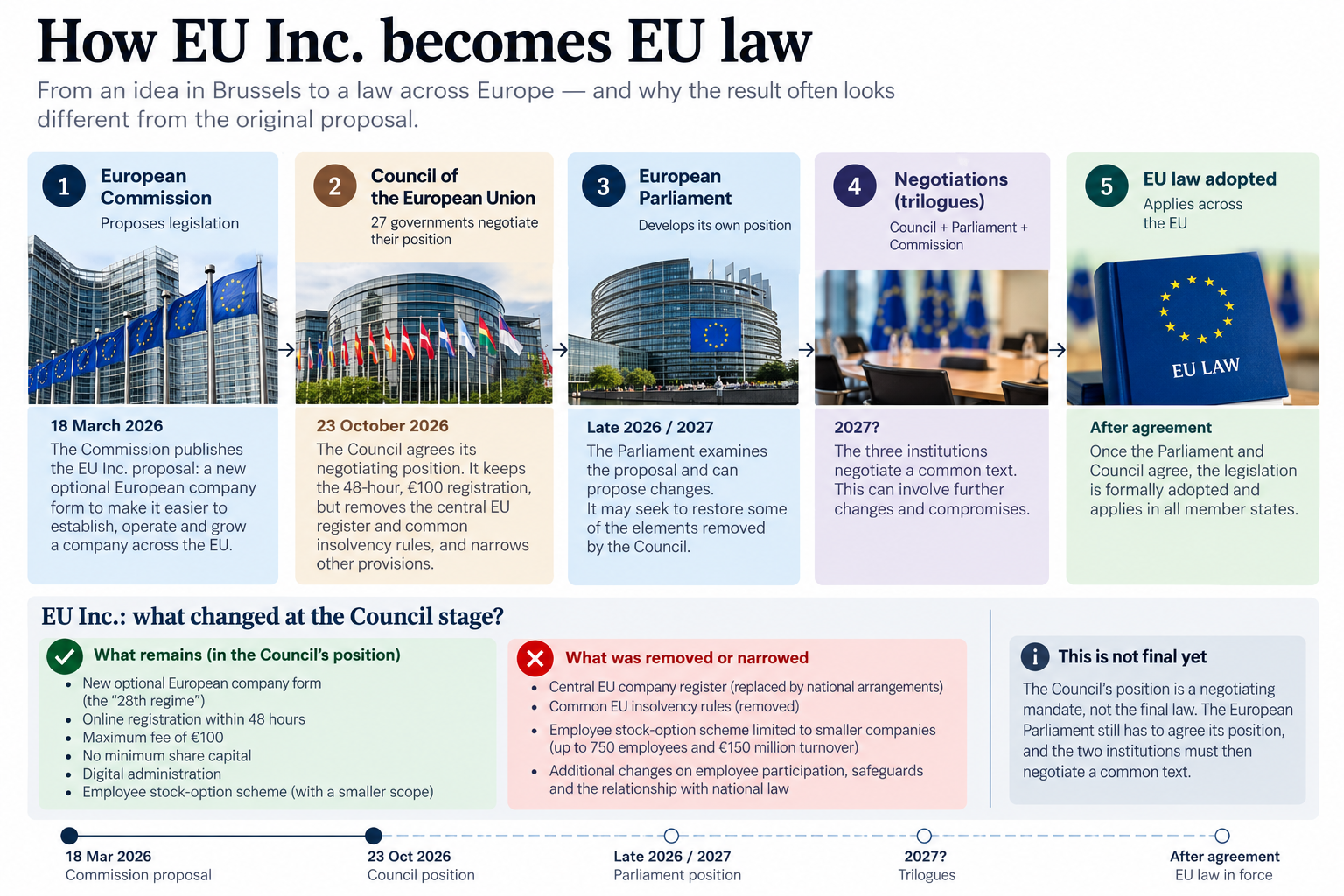
Under the ordinary legislative procedure, two institutions must agree on the legislation: the European Parliament and the Council of the European Union.
The Parliament represents European citizens through directly elected members.
The Council represents the governments of the 27 member states.
And those governments don't simply approve or reject what the Commission proposes. They negotiate it, often in considerable detail.
The Parliament and Council examine the proposal in parallel, each developing its own position before negotiating a common text.
This is where things became interesting.
What is the Council, exactly?
The terminology alone can be confusing.
There is the European Council, consisting of the heads of state or government. It determines the EU's broad political direction.
There is the Council of the European Union, where national ministers negotiate and adopt legislation.
And there is the Council of Europe, which is not an EU institution at all.
For EU Inc., we're talking about the second one.
But ministers don't personally negotiate every article of every proposed law.
Much of the work takes place in working parties consisting of officials from the member states. Their discussions are coordinated by the country holding the rotating Council presidency.
Issues that cannot be settled at this technical level can move to Coreper, the Committee of Permanent Representatives, where member states' ambassadors prepare decisions and negotiate compromises.
Eventually, the Council agrees on a position that can serve as the basis for negotiations with Parliament.
What surprised me was how much a Commission proposal can change during this stage, before the final negotiations between the institutions even begin.
What happened to EU Inc.?
On 23 October 2026, the Council adopted its negotiating position on EU Inc., under the Irish presidency.
The basic concept survived.
Companies would still be able to choose the new European legal form, register digitally within 48 hours for a maximum of €100, and use the framework across the single market.
But the Council's position changes the Commission's original proposal in important ways.
The Commission had envisaged a central European registration interface. The Council's compromise moves away from that approach, relying more heavily on national registration arrangements.
The original proposal also included harmonised procedures for certain insolvency situations. Those provisions have been removed from the Council's position.
The employee stock-option arrangements remain, but their scope has been narrowed. The Council's version limits them to smaller companies, including thresholds of 750 employees and €150 million in annual turnover.
Other changes concern employee participation, safeguards and the relationship between EU Inc. and national legislation.
These changes don't all have the same purpose. Some preserve national regulatory arrangements, while others address legal protections or implementation concerns.
But together, they raise an important question: how much of the original ambition to reduce fragmentation will survive?
Why does this happen?
This was the next thing I wanted to understand.
Why would national governments seek changes to a proposal intended to make European entrepreneurship easier?
At first, it seems contradictory. Almost every European government talks about competitiveness, innovation and the need for European companies to grow.
But a common European legal framework touches areas where national governments have developed their own systems over many decades.
Company registers are part of national legal infrastructures. Insolvency rules determine what happens to creditors, employees and investors when a company fails. Employee participation is deeply embedded in the legal traditions of some countries.
Harmonising these arrangements isn't simply a matter of removing paperwork.
It can mean changing which rules apply, which protections remain in place and how national institutions operate.
Different stakeholders therefore see different risks and opportunities.
Startup organisations argue that preserving too many national requirements undermines the purpose of a common European company form. Trade unions and legal professionals have raised concerns about worker protections, legal certainty and safeguards against misuse.
These are substantive disagreements.
They also explain why a proposal that attracts broad political support can become much more difficult once its individual provisions are negotiated.
The Council's position is the result of those negotiations. It reflects a compromise between governments, rather than the original ambitions of the Commission alone.
A European company, or just European registration?
There is a distinction I've kept returning to while following EU Inc.
Making it easier to register a company is not the same as making it easier to operate a company across Europe.
The former is relatively straightforward to measure: time, cost and administrative steps.
The latter depends on a much wider collection of rules governing ownership, financing, employees, restructuring and failure.
EU Inc. was intended to address parts of that larger problem.
Supporters of the initiative have warned that removing important provisions could leave Europe with a common company label without enough common rules.
The Council presents its changes differently, emphasising legal certainty, safeguards and the practical relationship with existing national systems.
Whether the resulting framework will significantly reduce fragmentation remains an open question.
This isn't the end of the story
There is another important point.
The Council has not adopted EU Inc. as law.
It has agreed on its negotiating position.
The European Parliament is developing its own position. Once both institutions have established their positions, negotiations can begin to produce a text they can both accept, with the Commission also participating.
These negotiations are commonly called trilogues.
The Parliament may seek to restore provisions removed by the Council. The Council may defend its changes. Further compromises may emerge.
Only when Parliament and Council agree on the legislation can it be formally adopted.
So what we're seeing now is not the final outcome of EU Inc., but an intermediate stage in the legislative process.
That makes it especially interesting to follow.
What I've learned so far
I began following EU Inc. because I was interested in the idea of a common European company framework.
I still am.
But following the proposal has also taught me something about European decision-making.
The European Commission can articulate a common ambition, but turning that ambition into law requires agreement between institutions representing different constituencies and interests.
National governments are not outside the European legislative process. They are an integral part of it.
And the detailed negotiations often begin long before the public becomes aware that a proposal is changing.
This also changes how I read European announcements.
A Commission proposal is an important step, but it is the beginning of a legislative process, not a promise of what the final law will contain.
EU Inc. provides a useful opportunity to observe that process in real time.
I intend to keep following it as the European Parliament develops its position and the negotiations continue.
Not because I expect the process to become simple, but because understanding how Europe makes its decisions seems increasingly important.
And perhaps the most useful question to keep asking is this:
When Europe agrees on an ambition, what happens when that ambition has to become law?
Sources and further reading
- European Commission: EU Inc., a new harmonised corporate legal regime
- Commission legislative proposal, COM(2026) 321
- Council of the EU: Negotiating position adopted on 23 October 2026
- European Parliament Research Service: The 28th regime corporate legal framework
Status: 24 October 2026. EU Inc. remains a legislative proposal. The Council's position is not the final legislation.