
Employee stock options: a small instrument with a larger economic purpose
How the Netherlands is changing the taxation of employee ownership, and what that reveals about innovation, capital and competitiveness.


The Netherlands cannot compete internationally simply by being cheaper. We have relatively high labour costs, limited natural resources and an economy that depends heavily on knowledge, productivity and international trade.
Our ability to create value matters more than our ability to reduce costs. Innovation is therefore not merely an attractive ambition. It is an important part of our economic model.
But developing an innovative economy requires more than funding research or encouraging entrepreneurship. Young companies need capital, skilled people and enough time to turn promising ideas into viable businesses.
At a recent Techleap meeting in Amsterdam, tax adviser Bas Jorissen of Archipel Tax Advise discussed proposed changes to the Dutch taxation of employee stock options.
One observation particularly caught my attention.
For a young company, the capital it can retain today may be considerably more valuable than the same amount of money spent on immediate remuneration. That money could finance product development, attract customers or help the business reach its next commercial milestone.
It is a straightforward observation, but it changes how we might think about employee compensation.
And it helps explain why something as technical as employee stock options can have a much larger economic purpose.

What is an ESOP?
An Employee Stock Option Plan, or ESOP, gives employees the right to acquire shares in their employer at a predetermined price, subject to certain conditions.
Suppose you join a startup and receive options to buy shares at a price agreed today. If the company grows substantially, those shares may eventually be worth considerably more than the price you pay.
The difference represents a potential financial reward for helping build the company.
But the outcome is uncertain. If the business fails or its value does not increase sufficiently, the options may be worth nothing.
Unlike an ordinary cash bonus, stock options allow employees to participate in the future value of the business. They become exposed to some of the same economic uncertainty as its founders and shareholders.
For a young company, this can be particularly useful.
An established business may be able to attract employees with substantial salaries and bonuses. A startup often needs equally capable people but cannot afford the same immediate cash expenditure.
Stock options offer another possibility. Employees accept some uncertainty in exchange for potential future rewards, while the company preserves capital for development and growth.
The arrangement is not free. Existing shareholders may face dilution, and employees may never receive a meaningful return. But it provides a way to share both the risks and potential rewards of building a business.
The Dutch tax problem
There has been an important complication in the Netherlands.
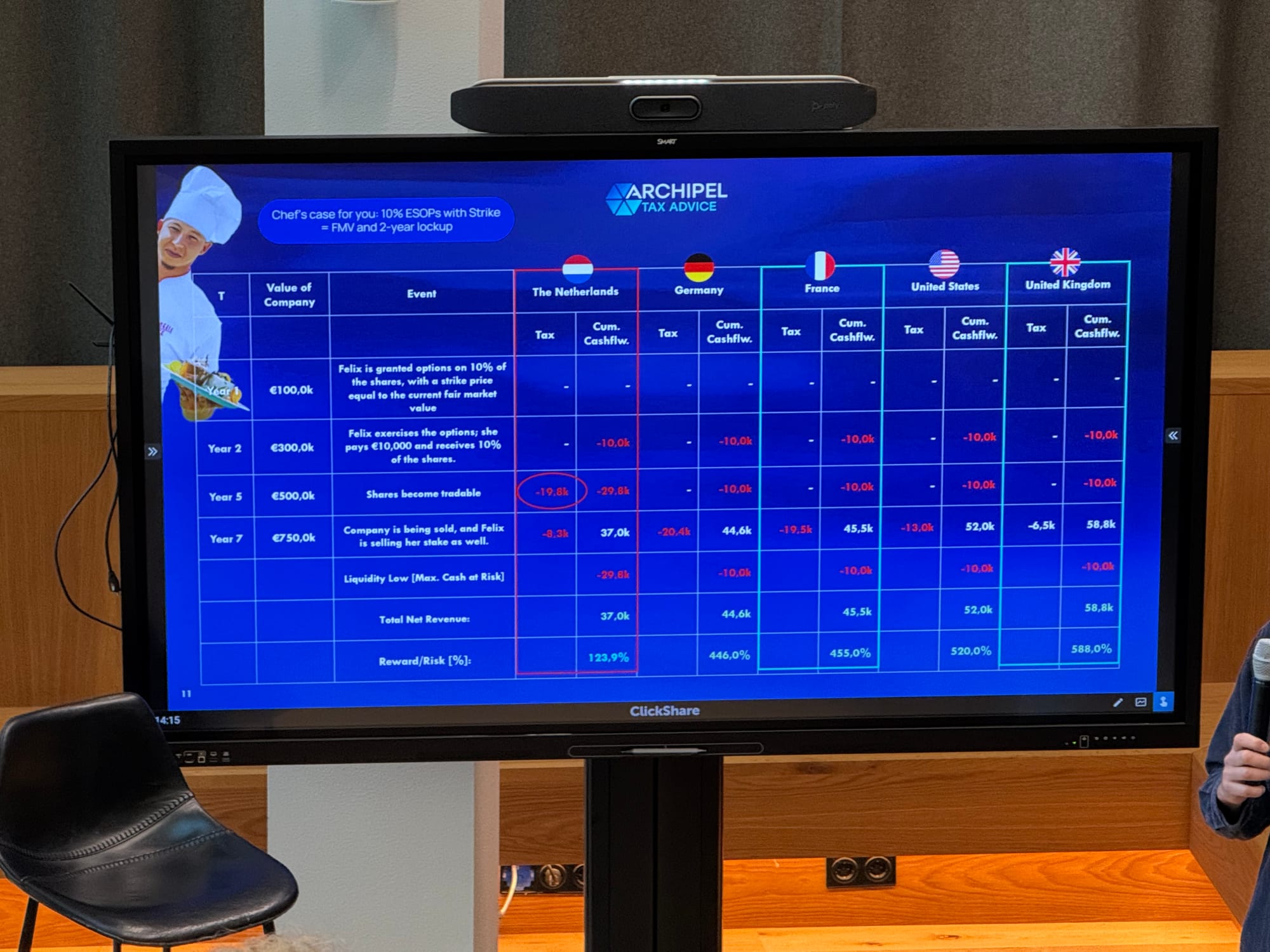
Employee stock options are generally treated as employment-related benefits. Under the current framework, taxation can arise when the shares acquired through exercising options become tradable, even if the employee has not actually sold them.
This creates the possibility of a tax bill without corresponding cash proceeds.
For someone working at a young company, that can be a considerable problem. The employee may hold something that has substantial value on paper but cannot easily turn it into money.
The proposed Dutch reform, intended to take effect in 2027, aims to improve the treatment of qualifying employee stock options.
Two changes are particularly important.
First, qualifying employees would generally be taxed when they actually sell their shares, rather than at an earlier moment when the shares become tradable.
Second, 35% of the qualifying benefit would be exempt from wage taxation. At the highest marginal rate, this would result in an effective rate of approximately 32% on the qualifying benefit.
The intention is to make employee participation in young, innovative businesses more attractive and bring its treatment closer to the entrepreneurial risk associated with founding a company.
The proposal is not a general tax reduction for everyone receiving stock options. It introduces eligibility requirements for companies and their option arrangements.
At the time of the Techleap meeting, the reform was still subject to legislative approval.
The favourable treatment would not apply to every company offering employee stock options. It is intended for qualifying startups and scale-ups, with RVO responsible for assessing whether businesses meet the relevant criteria.
The proposed definition considers characteristics such as growth potential, scalability and the development or improvement of products, services, processes or technologies. This matters because the government is deliberately targeting businesses that may have considerable growth potential but limited financial resources. The tax advantage is intended to help them compete for talent.
A European competitiveness question
Employee ownership also exposes a broader European challenge.
Stock options are internationally recognised, but their legal and tax treatment differs considerably between countries.
A Dutch startup may compete for the same engineer, researcher or software developer as a company in London, Paris or Berlin. Yet the potential financial value of an employee option package can differ because of national tax rules, eligibility conditions and the timing of taxation.
These differences can affect how attractive a company is to prospective employees, particularly when competing against businesses with greater financial resources.
The European Union has also been exploring ways to make it easier for innovative companies to operate and grow across borders.
Employee ownership belongs in that discussion, although national taxation remains a significant source of complexity.
The Dutch proposal is therefore more than a domestic adjustment to wage taxation. It reflects a larger question about whether European businesses have the conditions they need to attract talent, retain capital and scale internationally.
Innovation is also about how value is shared
What interested me most about Jorissen's presentation was the connection between economic ambition and the practical mechanics of building a company.
We often discuss innovation in terms of research expenditure, patents, universities, subsidies and investment funds.
All are important. But even a technically promising business can struggle if it cannot attract the people it needs or must spend too much of its limited capital before reaching commercial viability.
Employee stock options address a small part of that problem.
They allow a company to offer employees something other than immediate cash. They also create a different relationship between work, ownership and the future value of the business.
This is not without complications. Employees take financial risks, founders give up some future ownership, and the eventual distribution of rewards depends on how the business develops.
But those are precisely the kinds of choices that shape an innovation economy.
Tax policy influences more than government revenue. It can change when people are rewarded, how risks are distributed and whether young businesses can preserve the resources they need to grow.
For a country such as the Netherlands, which depends on its ability to create value rather than compete on low costs, these details deserve attention.
We cannot assume that investment in research will automatically produce innovative businesses, or that innovative businesses will automatically become productive contributors to the economy.
Between an idea and a successful company lies an entire system of capital, people, incentives and institutions.
Employee stock options illustrate how closely these elements are connected. They allow young companies to attract talent, preserve scarce capital and share the value they create.
The proposed Dutch tax reform is therefore about more than employee compensation. It raises a broader question: how can public policy help innovative companies grow into successful businesses?