
Compute Is the Entry Ticket, Not the Game
Compute is necessary but not sufficient. A LinkedIn debate sharpened an argument about European AI infrastructure into a longer chain: energy to demand.

A few days ago, I wrote on LinkedIn that Europe faces an uncomfortable tension.
Many Europeans dislike our growing dependence on American and Chinese AI companies. At the same time, many are reluctant to accept the infrastructure required to reduce that dependence.
My conclusion was deliberately simple: sovereignty without infrastructure is just a slogan.
The post generated a thoughtful discussion among people working in AI, engineering, infrastructure, finance and technology strategy. Some agreed. Others challenged the scale, economics or premise of the argument.
The discussion did not make me abandon the original claim. It made the claim more precise.
Europe does not merely need more data centres or more GPUs. It needs a functioning system in which energy, infrastructure, capital, model development and committed demand reinforce one another.
Compute is necessary. But it is not sufficient.
The strongest objection
The most important challenge was whether Europe really needs AI infrastructure on the scale now being proposed.
Demand may be overestimated. AI investments do not yet always produce convincing returns. Models are becoming more efficient. Personal computers and local devices may eventually run workloads that currently require centralised infrastructure.
This is especially relevant for inference: the everyday use of trained models. Inference can increasingly take place close to the user, inside organisations or on personal devices.
Training very large models is different. It still benefits from vast numbers of tightly connected processors, considerable energy capacity and specialised cooling and networking. That is the main logic behind the proposed AI gigafactories.
But even there, the future is uncertain.
The question is therefore not whether every announced data centre will prove necessary. Some almost certainly will not. The more difficult question is which mistake Europe can most easily recover from.
Building somewhat ahead of demand may produce underused capacity for a period. Failing to build strategic capacity may leave Europe unable to respond when demand does materialise. Grid connections, energy systems, specialist facilities and supply chains cannot be created overnight.
There is an asymmetry here. Overcapacity is expensive. Structural absence may be much harder to reverse.
Infrastructure does not equal sovereignty
A second criticism was equally important.
A European data centre filled with American chips, running American models for European customers, does not automatically make Europe technologically sovereign.
Europe could end up hosting other people's intelligence.
The buildings might stand on European soil, while the models, updates, platforms and economic value remain controlled elsewhere.
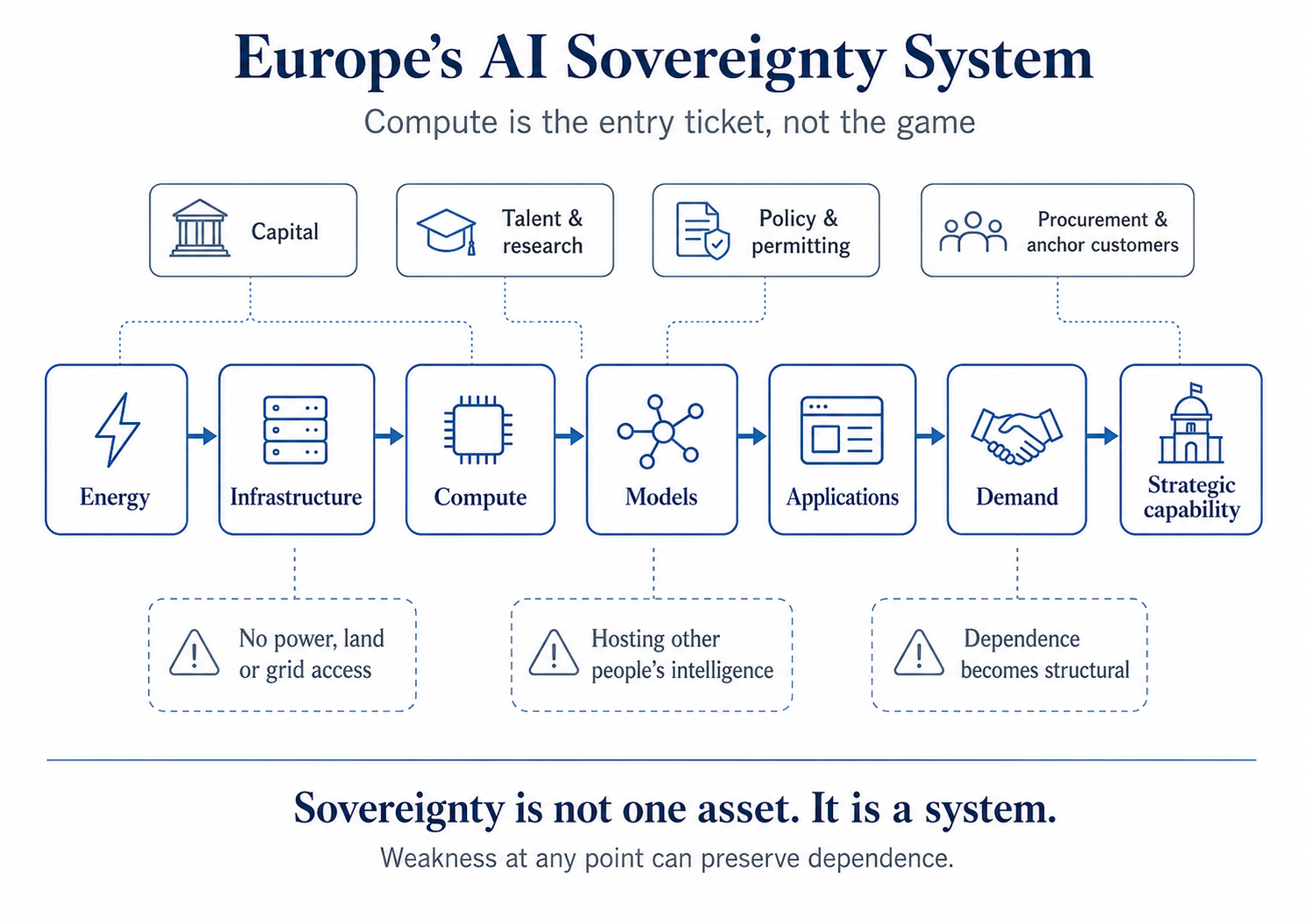
That is why compute should be understood as one part of a longer chain:
Energy → infrastructure → compute → models → applications → demand.
We can have data centres but no frontier model builders. We can develop models but lack the compute needed to train them. We can create capable technology but fail to produce commercially useful applications. We can call for European alternatives while governments and large enterprises continue to buy almost exclusively from American hyperscalers.
This is not primarily a question of locating servers within European borders. It is a question of whether Europe retains enough capability to make meaningful choices.
Compute is the entry ticket, as one commenter put it. It is not the game.
But without the entry ticket, there is little chance of becoming a serious player.
The wrong public-versus-private debate
The discussion also exposed a misleading choice in the way the issue is often framed.
Either the market builds the infrastructure, or governments write enormous cheques for GPUs.
I do not think governments should build frontier AI companies. They are unlikely to be good at choosing models, managing product development or competing in rapidly changing technology markets.
Private companies should build, experiment and compete.
But governments have always played a legitimate role in enabling strategic infrastructure. Ports, airports, electricity grids, railways, research institutions and telecommunications networks were not created by pretending that the surrounding conditions did not matter.
AI infrastructure has some of the same characteristics.
It requires energy availability, grid connections, land, permits, specialist construction, long investment horizons and predictable demand. These are not matters that individual technology companies can always solve by themselves.
The role of government is therefore not necessarily to become the owner or operator. It is to help create the conditions in which investment becomes possible and competition can develop.
That can include faster permitting, energy planning, research support, education, shared facilities and public procurement.
Where public money is involved, there should also be a public return. That might mean access for researchers and start-ups, support for education, capacity for public services, or conditions that prevent public investment from becoming a simple subsidy for one private company.
The companies should compete. The infrastructure should make competition possible.
Capital is only part of the problem
Several contributors focused on the enormous sums required. They were right to do so.
Serious AI infrastructure requires billions, or at least hundreds of millions, long before it produces a return. Compute hardware is expensive and depreciates quickly. Power, cooling, storage, networking and construction add further cost.
But the discussion also helped clarify that this may be closer to infrastructure finance than conventional venture capital.
A large campus does not need to be financed by one investor in one decision. Land, grid access, buildings, energy systems, compute and operations can be financed in phases by different participants.
The decisive ingredient is not capital alone. It is bankable demand.
Long-term contracts, anchor tenants and credible procurement commitments can turn a speculative proposal into investable infrastructure. Without predictable utilisation, even abundant capital will remain cautious.
Europe has capital. It also has energy companies, institutional investors, technical expertise, universities and industrial customers.
What it often lacks is alignment between them.
Demand is a strategic decision too
This may be the least visible part of the sovereignty discussion.
European governments and companies frequently speak about reducing technological dependence. Yet their purchasing decisions continue to strengthen the same dependence.
That is understandable. American cloud and AI providers offer mature products, large ecosystems and operational certainty. Organisations cannot simply replace them with weaker alternatives in the name of sovereignty.
But European capability will not emerge without customers.
Demand is not something that appears only after the technology has been perfected. Early customers help finance infrastructure, shape products and create the experience needed to compete.
This does not mean forcing organisations to buy inferior European technology. It does mean becoming more deliberate about procurement, interoperability and the development of credible alternatives.
Sovereignty cannot be achieved solely through supply-side investment. Someone must be willing to buy what Europe builds.
A European system, not one enormous project
The Rotterdam proposal is interesting because it makes the scale of the question visible. But the strategic answer is unlikely to be one gigantic facility that solves Europe's AI dependence.
Different types of compute will be needed in different places.
Some capacity will support frontier model training. Some will serve universities and research institutes. Some will run sensitive public-sector applications. Much inference will be distributed across regional data centres, organisations and local devices.
Countries will also bring different advantages. France has abundant nuclear electricity. The Netherlands has strong digital infrastructure and international connections. Other countries have land, renewable energy, engineering capacity or specialised research ecosystems.
The question is whether these national assets remain isolated industrial projects or gradually become part of a more coherent European capability.
Europe may eventually need something resembling a compute union: not necessarily one centrally controlled system, but shared access, coordination and investment across borders.
That debate has barely begun.
From sovereignty as location to sovereignty as capability
My original argument was about infrastructure. I still believe the physical layer is too easily ignored.
Digital technology can appear weightless, but AI is remarkably material. It requires processors, electricity, water, buildings, networks and people. Wanting the benefits while rejecting every physical consequence is not a viable strategy.
But the discussion has also made the limitations of the original formulation clearer.
Sovereignty is not achieved merely by placing infrastructure within European borders. It requires capability across the chain, from energy and compute to models, applications and customers.
Europe does not need to reproduce the American or Chinese system exactly. It does need enough capacity to choose where it cooperates, where it depends and where it develops alternatives of its own.
The real question is therefore not whether Europe should build one particular gigafactory.
It is whether Europe intends to remain primarily a customer of other powers' AI systems, or whether it wants to retain the ability to become a producer as well.
Infrastructure does not answer that question.
But without infrastructure, the answer may already have been made for us.