
ChatGPT is dreaming about me
ChatGPT has become remarkably good at remembering me. I went looking for an explanation and discovered that memory is no longer just about saved facts: ChatGPT is continually synthesising what it learns about me.


ChatGPT has become remarkably good at remembering me.
Not just facts, but the shape of what I am working on. Projects appear, intensify and disappear. Interests shift. The way I use ChatGPT changes. Somehow, its memory seems to move with that.
I had noticed this without really understanding why.
Then this week I tried to save a memory in ChatGPT Plus, and it would not let me do it in the way I expected.
That small annoyance sent me looking.
What I found is that ChatGPT Memory has changed quite fundamentally.
From remembering to synthesising
The original memory model was easy to understand: I told ChatGPT something mattered, and it saved that information as a memory.
The newer system works differently.
OpenAI describes it as a “continually updated synthesis” of what ChatGPT has learnt from previous conversations. Behind it is a background process it calls dreaming.
Instead of simply accumulating facts, the system keeps revising its understanding as new conversations happen and older information becomes less relevant.
That is the important shift.
Memory is no longer just a record of what was true. It tries to maintain a picture of what is true now.
A sliding window in time
I think that explains why it works so well for me.
My work changes quite quickly. Projects start and finish. Something I am investigating intensively for a few weeks may become irrelevant afterwards. New interests appear. Even the way I want ChatGPT to work with me develops.
A list of saved facts struggles with that. It knows what was true.
A synthesis can try to understand what is true now.
OpenAI gives the simple example of a planned trip. Before the trip, remembering that someone is going somewhere is useful. Afterwards, that same information needs to become part of their history rather than remain a current plan.
My experience is broader than that, but similar. Memory now feels more like a sliding window through my work and interests than a notebook I have been filling for years.
It is surprisingly seamless.
In OpenAI's terminology, ChatGPT is dreaming in the background. In use, it sometimes feels as though it is dreaming along with me.
The strange part: Business still remembers
I discovered all this because I initially thought I had found another difference between ChatGPT Plus and ChatGPT Business.
After Plus declined my familiar “remember this” instruction, I opened Business and tried the same thing with something harmless. I told it I was exploring quantum computing in education in the Netherlands and Europe.
Its response:
Memory updated.
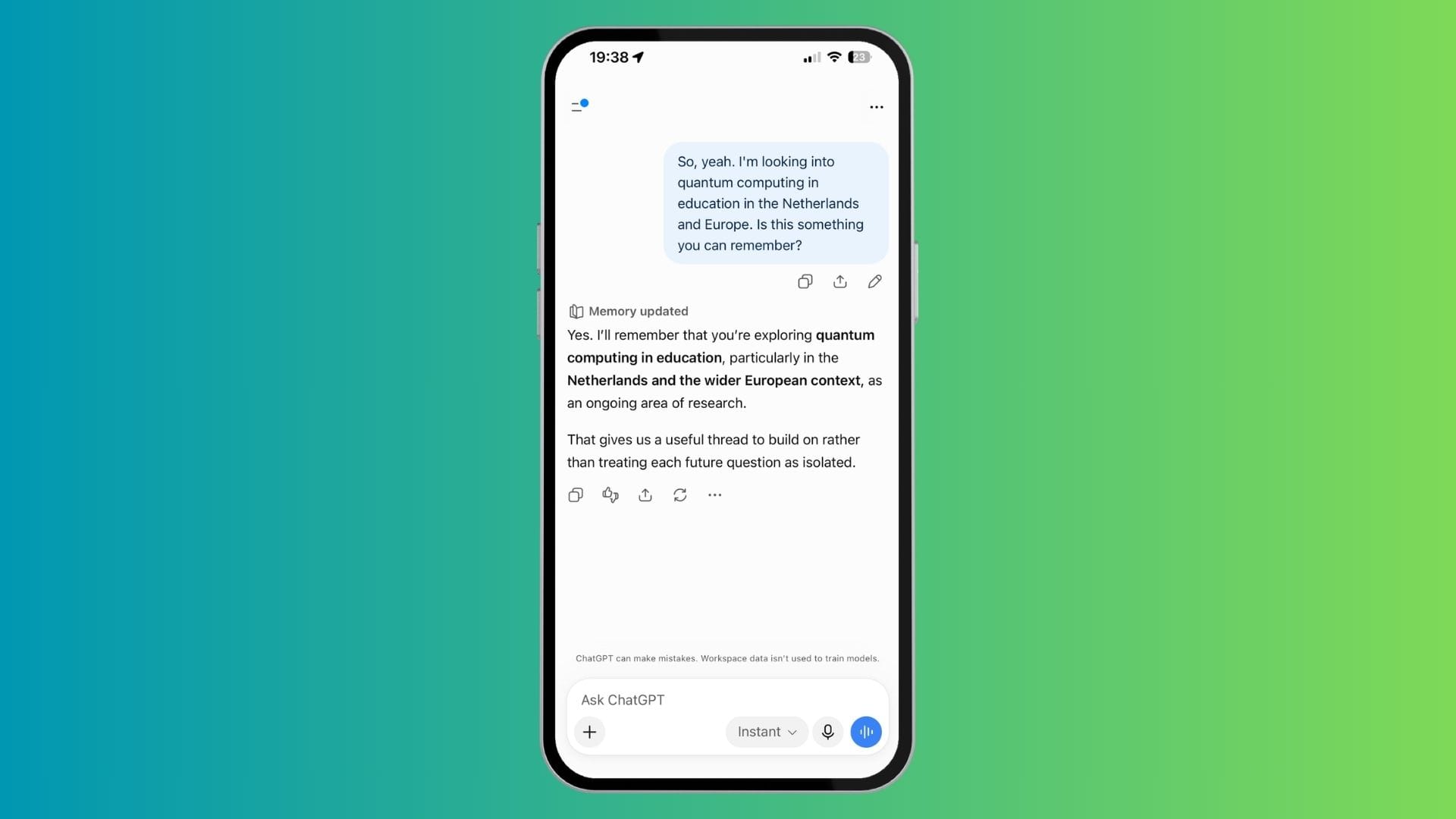
OpenAI says newer memory capabilities have also been rolling out to Business, so I don't think this is simply new memory versus old memory. But the different interaction was enough to send me looking.
And I am glad it did.
Better memory, less agency
There is a trade-off here.
With the old system, I had very direct agency. I decided what mattered and told ChatGPT to save it.
With dreaming, some of that judgement moves to the system. ChatGPT decides what is relevant, what should fade and how different pieces of context fit together. I can inspect a Memory Summary and correct things, but that summary is not necessarily everything ChatGPT remembers.
For me, so far, the trade seems worthwhile. I would not assume that is true for everyone. It probably depends on what you use ChatGPT for and how much continuity you want between conversations.
But memory is one of the things that determines how valuable an LLM becomes to me. A better model is useful. A model that increasingly understands the context in which I use it is something else.
I went looking because ChatGPT wouldn't let me save a memory.
I came away understanding why I might not want to go back.